











Amazon SageMaker

Develop, train, and deploy machine learning models using an integrated environment for data and analytics.
Amazon.com
Is this your tool?
Follow for updates & deals
Get alerts for Amazon SageMaker discounts, feature releases & pricing changes
Similar Tools

cubic
Automates code reviews and provides instant feedback on pull requests to enhance coding efficiency.

LangSmith
Platform for debugging, monitoring, and evaluating performance of LLM applications.

Ciroos
AI-powered support for Site Reliability Engineers to automate incident management and streamline workflows.

CodeWiki
Automatically updates code documentation and provides AI-driven Q&A support for developers.

Langfuse
An open-source platform for developing, debugging, and monitoring Large Language Model applications.

Amazon SageMaker Media Gallery

Amazon SageMaker (review) video
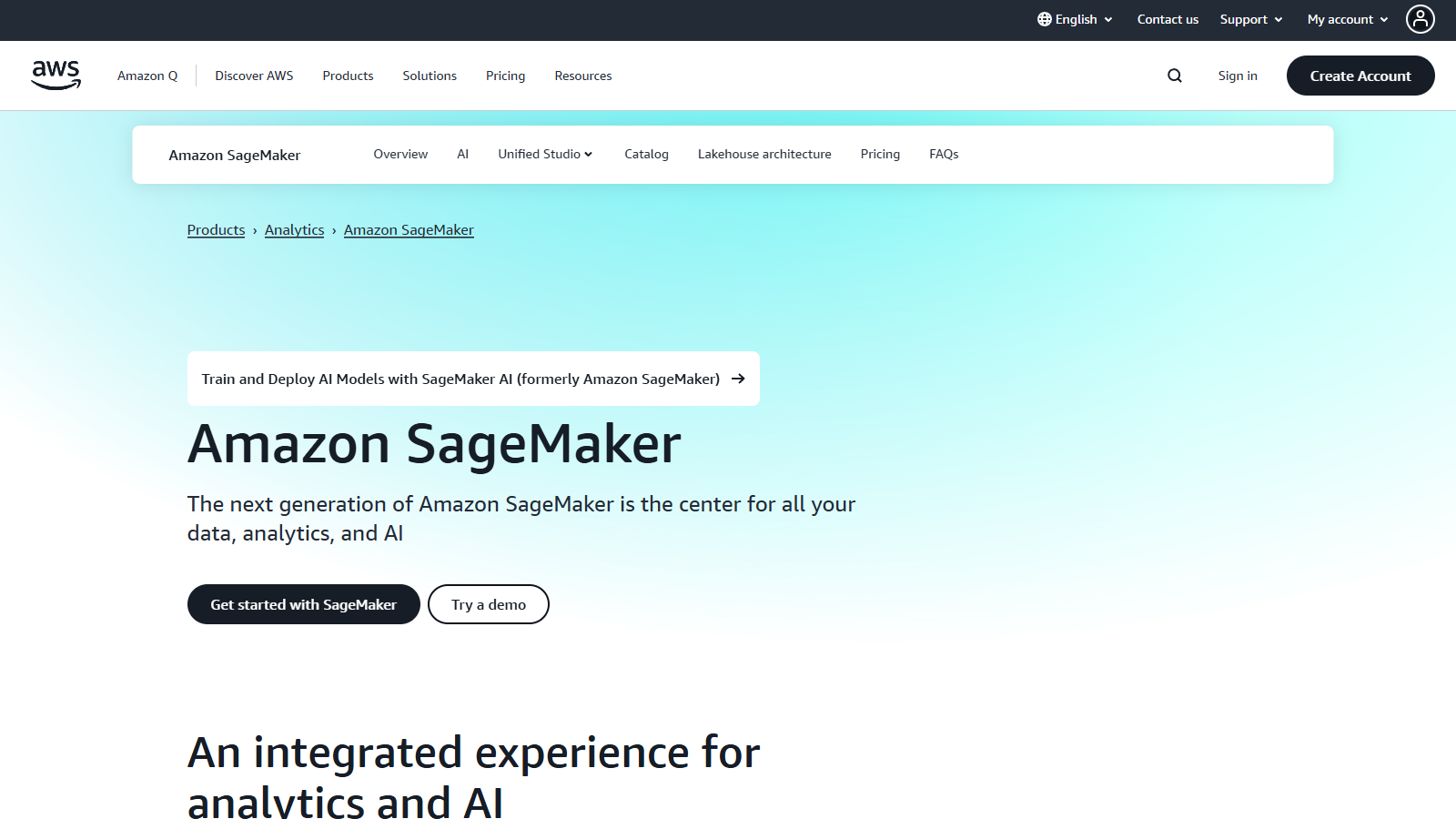
Screenshot of Amazon SageMaker
What is Amazon SageMaker?
Amazon SageMaker is an advanced and comprehensive suite designed to facilitate the development, training, and deployment of machine learning models effortlessly. As the hub for data analytics and AI, it provides an integrated experience that allows users to leverage their data efficiently, enhancing collaboration across various organizational levels. The next generation of SageMaker marks a significant evolution, going beyond traditional capabilities to empower organizations to harness the true potential of machine learning (ML) and artificial intelligence (AI).
Key Features:
Unified Studio
A standout feature of Amazon SageMaker is its Unified Studio, which serves as a single development environment. This innovation allows users to access a variety of tools for analytics and AI without encountering data silos, thereby enhancing teamwork and accelerating the modeling process. Through this unified approach, data scientists and ML engineers can collaborate effectively, utilizing familiar AWS tools and workflows.
Model Development and Deployment
With Amazon SageMaker, developing and deploying ML models is a straightforward journey. It offers fully managed infrastructure and robust workflow tools, enabling rapid model training and deployment across diverse use cases. The platform supports not only training foundation models (FMs) but also the implementation of custom ML solutions, addressing various organizational needs with flexibility and efficiency.
Data Governance
In today's enterprise environments, security and governance are critically important. Amazon SageMaker excels in this dimension by integrating data governance practices throughout the entire data and AI lifecycle. Organizations can manage access to sensitive data and models effectively, ensuring that only authorized personnel can interact with critical assets. The Amazon SageMaker Catalog facilitates this governance, allowing for fine-grained access controls that are pivotal in maintaining data integrity.
Innovative Lakehouse Architecture
One of the most exciting advancements in the latest iteration of SageMaker is its lakehouse architecture, which unifies data access across Amazon S3 data lakes, Amazon Redshift data warehouses, and third-party or federated data sources. This architecture promotes a streamlined experience by allowing users to query and analyze their data without the barriers of traditional storage systems. It enables seamless data management with zero-ETL integrations, which significantly reduces the complexity of data movement and enhances data availability.
Enhanced AI Development Capabilities
The next generation of Amazon SageMaker is packed with powerful AI development capabilities that are secure by design. Users can train, customize, and deploy ML and foundation models on a highly performant infrastructure. It includes purpose-built tools that span the entire AI lifecycle—from integrated development environments (IDEs) to governance and observability—helping businesses scale AI applications effectively. The integration of Amazon Q Developer, the most capable generative AI assistant for software development, enhances overall productivity by enabling users to leverage natural language for a variety of tasks, including data discovery and SQL query generation.
Generative AI Applications
Moreover, SageMaker offers innovative tools for developers to build and scale generative AI applications, paving the way for customized solutions tailored to specific business needs. This capability allows organizations to innovate and expand their AI footprint rapidly while adhering to responsible AI practices.
Affordable Pricing Model
Amazon SageMaker operates on a flexible pricing model that includes a comprehensive Free Tier, allowing users to utilize core functionalities without incurring upfront costs. This tier is especially advantageous for new users looking to get acquainted with the platform. For established users, costs vary based on usage patterns across AWS services utilized within SageMaker Unified Studio.
Benefits of Using Amazon SageMaker
Organizations adopting Amazon SageMaker can expect to develop AI models sustainably and efficiently. By reducing reliance on disparate data sources, SageMaker centralizes datasets from Amazon S3 and Amazon Redshift, enabling improved data-driven decision-making. With this holistic access to data, rapid iterations in model development and deployment become possible, significantly boosting organizational agility.
Conclusion
In conclusion, Amazon SageMaker stands out as a robust solution for businesses striving to unlock the full potential of AI and ML. With its user-friendly interface, powerful tools, and emphasis on data governance, it provides a clear pathway for organizations embarking on their AI journey. The enhancements in its Unified Studio and lakehouse architecture position it as a key player in the evolving landscape of AI and analytics.
Pros & Cons
Pros
- Offers a unified environment for ML model development and deployment.
- Integrates data processing and governance seamlessly across various sources.
- Supports generative AI application development with advanced tools.
Cons
- Requires AWS account for full functionality and services.
Frequently Asked Questions
Amazon SageMaker is free to start, with paid plans from 0 to 0 USD per Translation not found for 'time_period_unknown'.
According to our latest information, this tool does not seem to have a lifetime deal at the moment, unfortunately.
Amazon SageMaker Unified Studio offers a comprehensive environment for data and AI development. Key capabilities include building, training, and deploying machine learning models, creating generative AI applications, performing SQL analytics, and processing data using open-source frameworks. It enables users to work seamlessly with diverse data sources while ensuring governance and collaboration through built-in tools and integrated services.
The lakehouse architecture in Amazon SageMaker unifies data from Amazon S3 data lakes and Amazon Redshift data warehouses into a single accessible platform. This architecture reduces data silos, allowing users to perform analytics and AI on a unified dataset while applying fine-grained permissions. It also supports zero-ETL integration to bring operational data into the lakehouse in near real-time, enhancing the accessibility and usability of data across various applications.
Amazon SageMaker incorporates robust security measures throughout the data and AI lifecycle. It provides end-to-end governance by allowing users to set fine-grained access controls, define and enforce access policies, and monitor data quality. Additionally, it features data classification, toxicity detection, and compliance tools to safeguard AI models and ensure responsible usage of data across the organization.
Yes, Amazon SageMaker is designed to integrate seamlessly with various AWS services. It can utilize services like Amazon Redshift for SQL analytics, Amazon S3 for data storage, and AWS Glue for data preparation. Additionally, it allows you to leverage tools from other AWS products to enhance your machine learning workflows, significantly expanding your data processing and analysis capabilities.
Amazon Q Developer enhances the SageMaker experience by providing a generative AI assistant that simplifies coding, testing, and resource optimization. It allows users to generate SQL queries and create data pipeline jobs using natural language, making data discovery and model development faster and more intuitive. This tool accelerates the AI development process by enabling smoother collaboration and quicker access to necessary data and resources.
Amazon SageMaker supports the development of various machine learning models, including traditional ML models and foundation models (FMs). Users can build, train, and deploy models for any use case, leveraging fully managed infrastructure and workflows. This flexibility enables organizations to tailor their models to meet the specific business needs of various industries and applications.
To start using Amazon SageMaker, you can create an AWS account if you don't already have one. Then, you can access the SageMaker Unified Studio, where you'll find tools to manage projects, user roles, and data sources. AWS also provides a quick setup option to streamline the initial domain creation process. For detailed guidance, check the official documentation and tutorials available on the AWS website.
Yes, businesses can leverage Amazon SageMaker for a variety of use cases, such as unifying and governing data across different departments, scaling AI applications, and performing advanced analytics. For instance, companies like Toyota have implemented SageMaker to streamline data access across their operations, improving data discoverability and facilitating the development of generative AI applications to enhance customer satisfaction and operational efficiency.