











CarbonRunner
Optimizes AI and CI/CD workloads by minimizing carbon emissions through real-time energy sourcing.
Carbonrunner.io
Is this your tool?
Follow for updates & deals
Get alerts for CarbonRunner discounts, feature releases & pricing changes
Similar Tools

Aidoc
AI tools for automating medical imaging analysis and enhancing patient management workflows.

LeadIQ
AI-driven tool for enriching CRM data and streamlining B2B sales prospecting efforts.

Creem
Smooth payments for SaaS and Indie Hackers.

Plotch.ai
Create and oversee AI agents for workflow automation in enterprise settings.

People.ai
Automates data capture and optimizes sales operations for better revenue management

CarbonRunner Media Gallery
What is CarbonRunner?
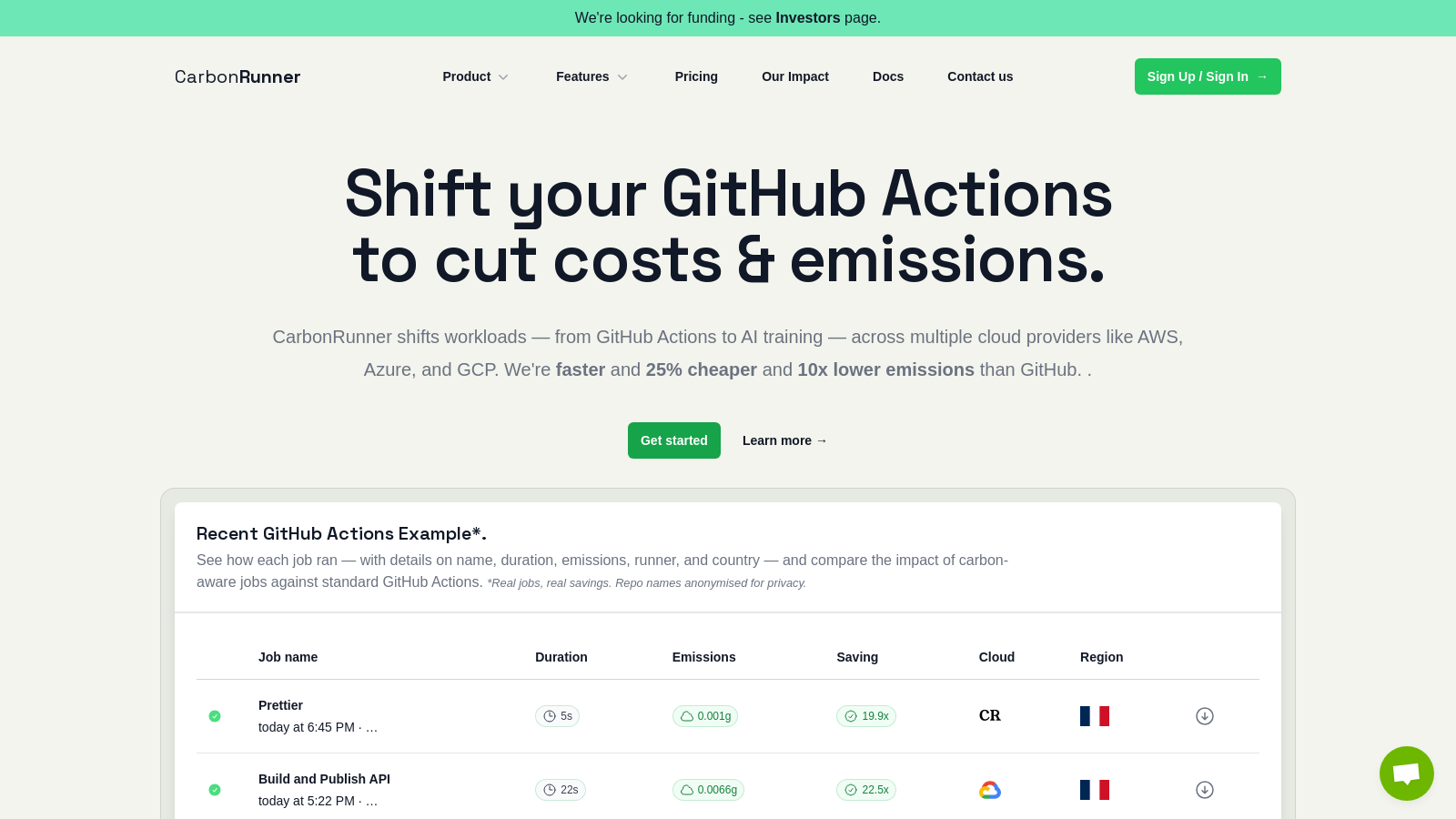
CarbonRunner is at the forefront of revolutionizing cloud workflows with its innovative carbon-aware compute architecture, meticulously designed for CI/CD pipelines and AI training on major cloud platforms such as AWS, Azure, and Google Cloud Platform (GCP). This service is committed to advancing sustainability and operational efficiency by dynamically shifting workloads in real-time to reduce carbon emissions while simultaneously maximizing cost savings.
By leveraging live grid data, CarbonRunner ensures that job executions take place in regions with the lowest carbon intensity. This unique methodology results in significant reductions in CO₂ emissions—up to an astounding 90% when compared to traditional approaches. Notably, users have reported experiencing a reduction in operational costs by about 25% compared to standard cloud runners, making CarbonRunner an exceptionally attractive solution for businesses of all scales.
Features of CarbonRunner
The exceptional features of CarbonRunner address an urgent need for both sustainability and operational efficiency. Here are some of the standout elements:
- Multi-Cloud Optimization: CarbonRunner supports seamless integration with numerous cloud providers, allowing for real-time selection of the most sustainable infrastructure based on current carbon intensity, thereby enhancing both resilience and service performance.
- Cost Efficiency: Users typically save approximately 25% in operational costs compared to using default cloud runners, making CarbonRunner a compelling choice for organizations aiming to balance efficiency with budget considerations.
- Comprehensive Reporting: With real-time insights and reporting features, users can monitor job performance alongside their carbon footprint, enabling informed decision-making aligned with corporate sustainability objectives.
- Reduced Latency: Thanks to its distributed architecture, CarbonRunner ensures rapid job execution by efficiently managing operations across various geographical locations.
How CarbonRunner Works
Transitioning to CarbonRunner is straightforward. Users can adapt their existing workflows with a single line modification in their configuration files. This results in jobs being automatically rerouted to cleaner, more economical energy sources in real-time, enhancing both performance metrics and sustainability efforts.
The technology underlying CarbonRunner encompasses a network of servers across multiple cloud providers that continuously monitor real-time carbon intensity metrics. Decisions regarding job execution locations are made based on this data, ensuring minimal carbon output throughout the tech industry’s operations.
Advanced Features for Enterprises
CarbonRunner is designed with scalability in mind to meet enterprise needs. For instance, companies can save over NULL,000 annually by switching from conventional cloud runners to CarbonRunner while concurrently achieving substantial reductions in carbon emissions. Such results solidify the tool's appeal for organizations committed to aligning their operations with environmental accountability.
Seamless Integration with GitHub Actions
CarbonRunner enables effortless integration with GitHub Actions to execute workflows in the most eco-friendly regions, thereby reducing environmental footprints while improving operational efficiencies. By utilizing real-time carbon data, CarbonRunner guarantees that actions run in locations characterized by the lowest CO₂ emissions, significantly alleviating the environmental impact of development processes.
Furthermore, GitHub Actions optimized by CarbonRunner not only achieve a remarkable reduction in carbon emissions—up to 90%—but also effectively lower operational costs, making sustainable practices more accessible and affordable for development teams.
Multi-Provider Support
Having access to numerous cloud providers, including AWS, Azure, and those soon to include Oracle and Google Cloud, is a key advantage of CarbonRunner. Its capability to intelligently distribute workloads based on real-time data ensures that jobs are executed with the least environmental impact possible.
Join the Movement Towards Sustainability
In summary, CarbonRunner is not simply a cloud computing service; it represents an essential stride towards sustainable technological practices. By selecting CarbonRunner, organizations not only enhance operational efficiency but also actively participate in global sustainability initiatives. The tooling empowers companies to make every job within their workflows contribute to the overarching mission of fostering a cleaner, more sustainable planet.
Pros & Cons
Pros
- Dynamic workload shifting achieves up to 90% reduction in CO₂ emissions.
- Integrates seamlessly with multiple CI/CD platforms, not just GitHub Actions.
- Offers multi-cloud support, utilizing real-time data for cost-effective, green computing.
Cons
- May incur additional time costs for uncommon configurations not readily available.
Frequently Asked Questions
We have no pricing information available now, so please check the CarbonRunner's website.
According to our latest information, this tool does not seem to have a lifetime deal at the moment, unfortunately.
CarbonRunner integrates seamlessly with all major CI/CD platforms, including GitHub Actions, Bitbucket, GitLab, and CircleCI. This allows users to shift their workloads across multiple cloud providers like AWS, Azure, and GCP, optimizing costs and emissions without changing their current workflow setup. By using a simple one-line code change in your workflows, you can leverage CarbonRunner's capabilities to enhance your CI/CD processes.
CarbonRunner utilizes real-time grid data to monitor carbon intensity across different regions. It automatically routes your workloads to servers in the locations with the lowest carbon emissions at the time of execution, typically achieving an average intensity of around 24 gCO₂/kWh—about 90% less than standard cloud providers. This dynamic workload shifting allows for significant reductions in CO₂ emissions while maintaining performance.
Yes! CarbonRunner provides users with the ability to specify region preferences for their jobs. This means that if you have compliance or governance requirements, you can ensure that workloads are executed within specific geographical bounds. However, it's important to note that while certain regions may have lower carbon emissions, they may not always be the best option for sustainability. CarbonRunner will still only run jobs in areas with a carbon intensity below 100g CO₂/kWh.
CarbonRunner is versatile and can shift various types of workloads, including CI/CD jobs, AI training models, data pipelines, and batch processing. This flexibility makes it suitable for a wide range of applications across different sectors, ensuring that you can optimize your entire workflow for both cost and environmental impact.
By dynamically shifting workloads to the cheapest and cleanest cloud regions, CarbonRunner can reduce operational costs by an average of 25% compared to traditional CI/CD solutions like GitHub Actions. This is achieved without sacrificing performance, allowing enterprises to not only save money but also significantly cut their carbon emissions—offering a dual benefit of sustainability and financial efficiency.
Getting started with CarbonRunner is straightforward. The platform offers comprehensive setup guides and documentation on its website, including detailed breakdowns on how to integrate CarbonRunner into your existing workflows. Additionally, the support team is readily available to help users with any questions or issues they may encounter during the setup process.
While CarbonRunner provides extensive functionality for CI/CD workloads across multiple cloud providers, certain configurations, such as specific runtime environments or uncommon setups, may incur longer start times, typically around 45 to 90 seconds, due to the provisioning process. Users should also understand that while users can specify regions, it may not always guarantee the lowest emissions if local grid conditions are not optimal.
CarbonRunner estimates the carbon emissions for each job by considering various factors: the energy usage of the job derived from CPU power consumption, the carbon intensity of the grid at the time the job runs, and employing real-time energy generation data to calculate total emissions in grams of CO₂. This level of granularity allows users to see the environmental impact of their workflows more transparently.