











Consensus

Search engine designed to simplify access to scientific research papers and summarize key findings.
Consensus.app
Is this your tool?
Follow for updates & deals
Get alerts for Consensus discounts, feature releases & pricing changes
Similar Tools

Manus
Transforms user ideas into actionable tasks for enhanced productivity across various domains.

Flot
AI writing and memory tool that integrates with apps to enhance writing and recall information.

Dream Story
A journaling app that enhances personal growth through guided self-reflection and AI-assisted insights.

YouTLDR
Summarizes YouTube videos into concise insights and key points for quicker viewing.

remio
Automates data capture and knowledge management for personalized productivity support.

Consensus Media Gallery

Consensus (review) video
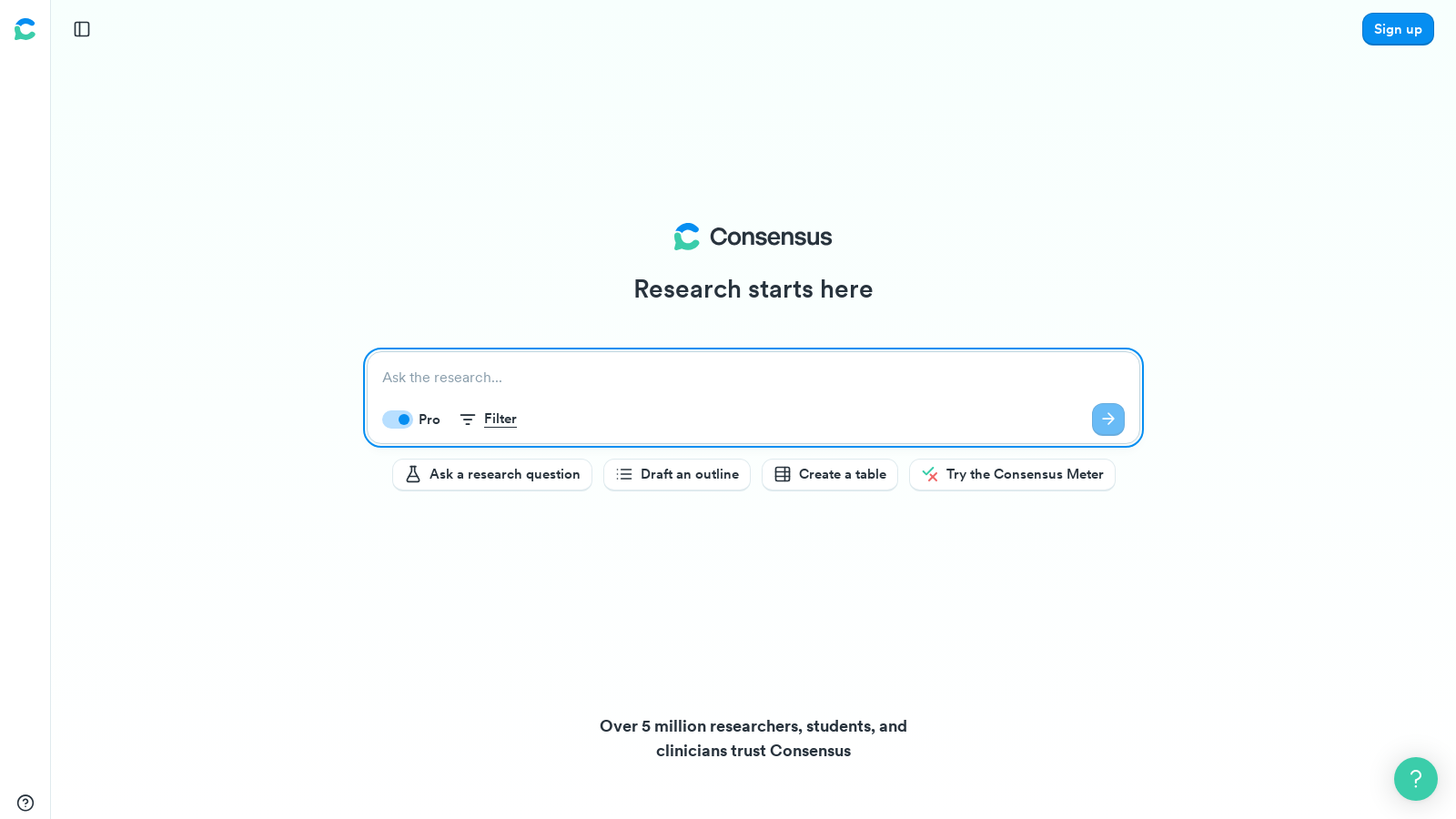
Screenshot of Consensus
What is Consensus?
Consensus is an innovative AI-powered search engine tailored specifically for navigating the vast and complex world of scientific research. In a landscape where information can often be overwhelming, Consensus enhances the search experience, making it not only simple and efficient but also highly relevant for researchers, educators, and students alike. Leveraging advanced artificial intelligence, the platform ensures that scholarly searches transform into intuitive, effective sessions, enabling access to trusted knowledge that's both accessible and comprehensible.
Understanding the Challenge: Given that over 250 million research papers exist and millions more are published annually, the challenge of locating reliable data can seem daunting, akin to finding a needle in a haystack. Academics, researchers, and students frequently encounter barriers when trying to sift through this enormous volume of literature, compounded by complex terminology and niche topics. Consensus aims to dismantle these barriers, allowing users to concentrate on what truly matters: gathering empirical evidence and knowledge relevant to their studies or projects.
How Consensus Works: At its heart, Consensus leverages state-of-the-art AI technology to sift through substantial databases of scholarly articles, returning results that are relevant to user queries. When users pose questions or enter specific topics into the search function, the engine highlights crucial insights, provides concise summaries, and includes citations that link back to the original studies. This not only facilitates quick discovery but also enhances understanding of the context and implications of the highlighted studies. Users can draft outlines, create tables for comparisons, and utilize innovative tools like the Consensus Meter to streamline their research workflow.
The design of the platform prioritizes user experience, offering an intuitive interface that ensures smooth navigation throughout various search journeys. Whether drafting a paper, consulting peer-reviewed sources, or embarking on a new research endeavor, Consensus is equipped with features that enhance productivity and facilitate high-quality work.
Who Uses Consensus? Over 10 million researchers, students, and clinicians across more than 10,000 universities and institutions now trust Consensus. Testimonials highlight its transformative effect on research workflows, with users noting significant time savings and an increase in academic productivity. Users have expressed delight in how Consensus clarifies complex topics, summarizes key findings succinctly, and connects users efficiently to crucial information.
One representative statement from a student emphasizes that “Consensus helps me gather real, peer-reviewed sources. It doesn’t write for me, but it sets me up to write with clarity and confidence.” Similarly, a PhD candidate remarked, “Consensus saves me countless hours by highlighting the most relevant papers with clear summaries and identifying their study designs. It has become essential to my dissertation workflow.”
The Journey Ahead: As Consensus progresses, its mission remains steadfast: to democratize access to the world's premier scientific knowledge. This mission transcends mere accessibility; it emphasizes enabling users to engage with research in a critical and constructive manner. Continuous updates and enhancements reflect the needs and feedback of its extensive community, ensuring that the tool evolves to remain at the forefront of academic research.
Consensus is not merely a tool; it embodies a movement towards a future in which exceptional quality research is readily available, fostering an environment where researchers, educators, and learners can thrive in their academic endeavors.
Pros & Cons
Pros
- Utilizes AI to efficiently summarize and synthesize peer-reviewed research.
- Trusted by over 5 million users, enhancing academic research processes.
- Designed to align with academic integrity, providing direct citations for sources.
Cons
- May not provide fully automated writing assistance, requiring user input.
Frequently Asked Questions
Consensus is free to start, with paid plans from 0 to 0 USD per Translation not found for 'time_period_unknown'.
According to our latest information, this tool does not seem to have a lifetime deal at the moment, unfortunately.
Consensus provides several unique features designed to enhance academic research, including AI-powered search results sourced from peer-reviewed articles, summaries of research papers, and analysis of study designs. Users can formulate research questions, draft outlines, and create comparison tables of research findings, which significantly streamline the literature review process. This combination of summarization and citation ensures integrity and reliability in academic writing.
University students and researchers can significantly benefit from Consensus by accessing over 10 million research papers quickly and efficiently. With tools designed specifically for academic use, Consensus helps users identify the most relevant studies, generate clear summaries, and understand complex methodologies, saving valuable research time. Students from over 10,000 universities currently leverage Consensus to elevate their academic work, ensuring they have access to high-quality, evidence-based resources.
Consensus allows users to explore a vast array of research topics across several domains, including medicine, psychology, environmental science, and more. Users can input specific questions about patient care, nutrition, fitness, and history, among others. Consensus is designed to return evidence-backed answers linked directly to cited research papers, which makes it a valuable tool for both academic and personal inquiries.
Yes, Consensus provides a comprehensive Help Center that includes FAQs, quick start guides, and detailed research tutorials. Users can access assistance for general inquiries, account troubleshooting, and features of the tool. The Help Center is designed to facilitate a seamless user experience and assist with any challenges you may encounter while using the platform.
Consensus is designed to integrate seamlessly with university systems, promoting accessibility for students and faculty. Universities can purchase a site-wide license or individual/group subscriptions to provide access to Consensus across departments. This collaborative integration helps enhance learning environments and ensures that users have access to the necessary tools for conducting ethical and practical research.
While Consensus is a powerful tool for academic research, it does have limitations. It primarily focuses on summarizing and synthesizing existing peer-reviewed literature and does not generate original content or provide access to non-reviewed sources. Users should be aware that while Consensus streamlines the search process, critical thinking and evaluation of sources remain essential when conducting research.
To get started with Consensus, sign up for a free account on their website. Upon creating your account, explore the Help Center for structured guides and tutorials that are tailored to help you utilize the platform effectively. Begin by asking specific research questions relevant to your studies, and leverage the tool's features to draft outlines and summaries. Through practice, you'll become proficient in navigating Consensus' capabilities.
While Consensus has proven to be an effective tool for academic research, alternatives exist, such as Google Scholar, PubMed, and other scholarly databases; however, these alternatives may not incorporate the exact AI-driven summarization and synthesis capabilities offered by Consensus. Users should evaluate different options based on their specific research needs and consider how each tool complements their workflow.