











Domino

Streamline data science workflows and MLOps with centralized governance and model management
Domino.ai
Is this your tool?
Follow for updates & deals
Get alerts for Domino discounts, feature releases & pricing changes
Similar Tools

Gretel
Generate synthetic datasets for AI applications while ensuring data privacy and compliance.

Promptfoo
Evaluate and secure large language model applications with an open-source command-line interface.

Ravelin
AI-powered fraud prevention and payment solutions tailored for online merchants

Wayve
Automated driving solution utilizing AI for safe and adaptable navigation without reliance on HD maps.

Scale AI
Provides high-quality training data and tools for developing AI applications across various sectors

Domino Media Gallery
What is Domino?
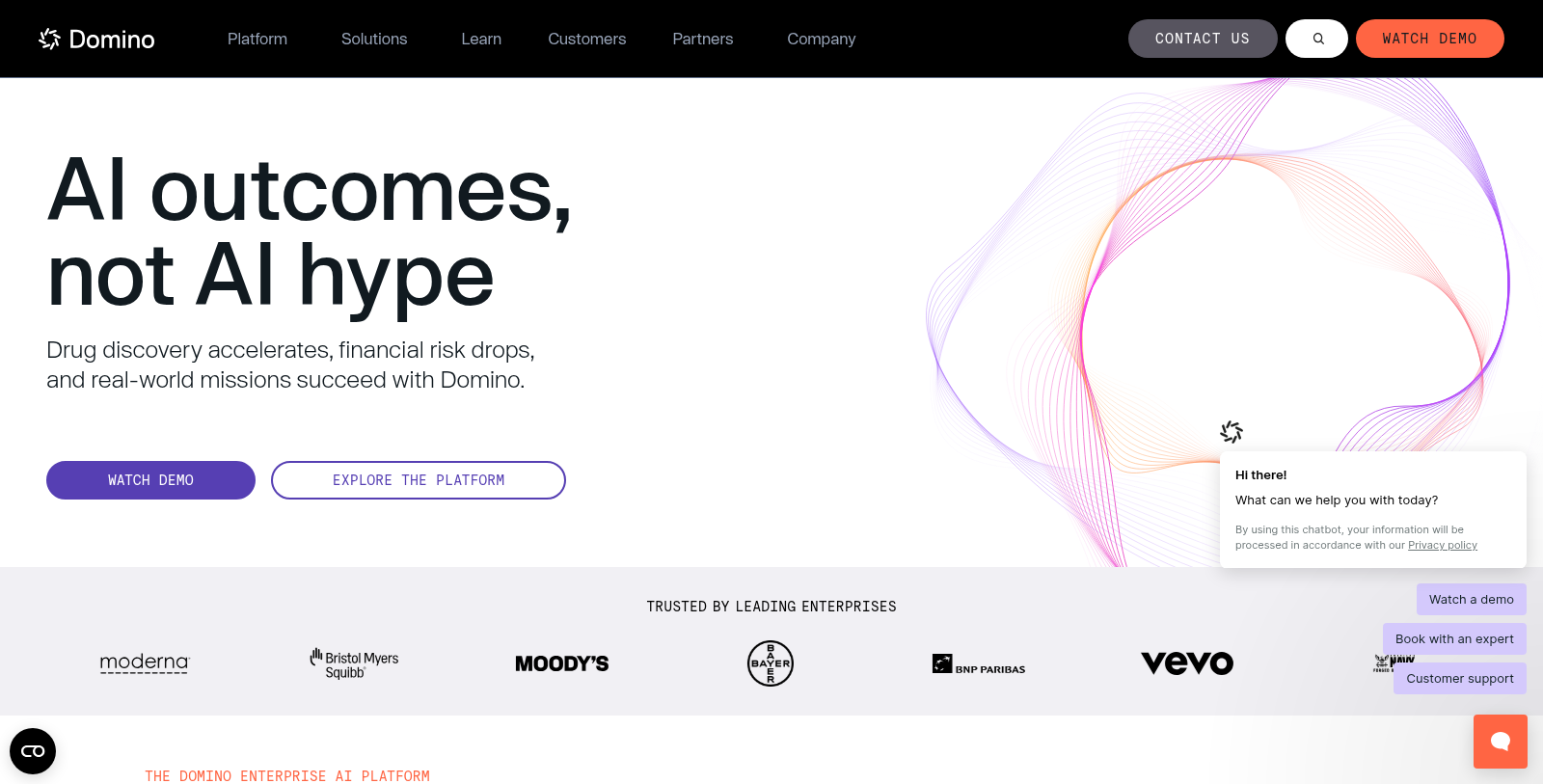
Domino is an Enterprise AI platform designed to streamline the workflows of data science and machine learning operations. By centralizing data science and AI tasks, Domino empowers organizations to innovate rapidly while maintaining governance and compliance. The platform allows data scientists to seamlessly build, deploy, and manage ML models with a high degree of efficiency.
What is Domino?
Domino serves as the operating system for AI business outcomes, transforming promising pilot projects into production-grade systems. It offers tools that integrate seamlessly into existing workflows, allowing teams to leverage their preferred technologies without being constrained by infrastructure. With the new Beta Launch, Domino is currently offering 50% off for the first 200 users, making it an enticing choice for those looking to get started with enterprise AI solutions.
Key Features
One of Domino's standout features is its ability to orchestrate AI across various environments, whether on-premises or in the cloud. The platform simplifies model deployments and provides robust monitoring capabilities to ensure models are performing optimally. With built-in governance tools, it tracks data and model lineage, ensuring compliance is met without slowing down innovation. Domino now also supports flexible credit usage models: users can access a monthly credit system based on their specific demands, ranging from basic to advanced tiers.
Flexibility and Scalability
Domino's architecture is designed for scalability. Users can quickly deploy models and applications across various infrastructures, including cloud-based environments and local servers. Hybrid and multi-cloud support enables enterprises to manage their AI workloads with flexibility, optimizing performance and cost. With subscription options available, including a free tier and several paid options with different credit packages, users can find a suitable model that aligns with their usage requirements.
Simplified Collaboration
Team collaboration is enhanced through Domino's ability to capture and track every project artifact. Data scientists can build on previous work, iterate rapidly, and maintain transparency in their experiments. The centralized platform simplifies onboarding for new team members, enabling them to become productive quickly. Additionally, with premium support and enterprise-level features like dedicated customer success management included in higher-tier subscriptions, teams are better positioned to leverage Domino’s capabilities.
Robust Governance
Regulatory compliance is a crucial aspect of many data science applications, especially in regulated industries like finance and healthcare. Domino automates governance processes, making it easier to adhere to internal and external standards while minimizing risk. The platform's traceability features provide a complete history of all models and data used in experiments. Recent enhancements also include sophisticated cost management tools that allow organizations to keep track of AI expenditures effectively, thereby maximizing their return on investment through intelligent allocation of resources.
Customer Success Stories
Various leading companies and organizations have deployed Domino to enhance their data science practices. The U.S. Navy uses Domino to improve its underwater mine-detection capabilities, achieving significant speed and accuracy in model updates. Bayer employs the platform to optimize agricultural output through data-driven insights. Additionally, Moody's has improved model monitoring capabilities fourfold while reducing model development time significantly. These success stories across diverse sectors demonstrate Domino's versatility and effectiveness, affirming its role as a pivotal tool in the enterprise data science landscape.
Conclusion
In summary, Domino is a comprehensive platform that addresses the complexities of enterprise-level AI and data science initiatives. By integrating powerful tools for workflow management, governance, and collaboration, Domino allows organizations to harness the full potential of their data. With its newly structured pricing model that facilitates easier entry into enterprise AI, Domino is transforming how organizations operate and innovate in an AI-driven world.
Pros & Cons
Pros
- Automates model lineage tracking for compliance and reproducibility across AI projects.
- Supports diverse tools and workflows, enhancing collaboration among data scientists.
- Accelerates deployment cycles, allowing rapid retraining and iterative improvements on models.
Frequently Asked Questions
Domino is free to start, with paid plans from 0 to 60 USD per month.
According to our latest information, this tool does not seem to have a lifetime deal at the moment, unfortunately.
Domino offers a comprehensive suite of features for enterprise AI, including support for hybrid and multicloud deployments, self-service data access for data scientists, automated model management, and built-in governance. Key capabilities include model tracking and monitoring, collaborative workspaces, integration with popular tools like R and Python, and robust APIs for model deployment. The platform is designed to optimize the entire data science lifecycle, enabling faster and more effective AI initiatives.
To get started with Domino, you can sign up for the free beta to get familiar with the platform and its functionalities. After that, explore the comprehensive documentation and training materials provided in Domino University, which offers courses for users and administrators. Additionally, consider watching the on-demand demo available on the website to see the platform in action. Once you are ready, you can start creating projects, using your preferred tools and languages.
Domino is tailored for various sectors, including financial services, life sciences, manufacturing, and government agencies. The platform enables organizations to leverage AI for a wide range of applications, including fraud detection, drug discovery, agricultural optimization, and advanced risk modeling. Companies that require a robust, scalable, and compliant solution for managing their AI initiatives will find Domino particularly valuable.
Yes, Domino integrates seamlessly with a wide range of tools and platforms. This includes common data science and analytics tools such as R, Python, and Jupyter, as well as collaborative applications like Google Docs and Notion. Moreover, it supports cloud service integrations with AWS, Azure, and Google Cloud, allowing for flexible deployment options. You can also connect to data sources and business intelligence tools such as Snowflake, enabling a comprehensive data science workflow.
Domino emphasizes built-in governance and compliance features tailored for regulated industries. The platform automatically tracks model lineage, providing an extensive audit trail that supports regulatory compliance. Governance policies can be standardized across projects to ensure model validation and monitoring practices meet industry standards, which is particularly critical for sectors such as finance and healthcare.
While Domino offers extensive capabilities, potential limitations include the steep learning curve for users unfamiliar with its interface and features. Organizations may also need to ensure adequate training and onboarding for their teams to leverage the platform effectively. Additionally, the platform is best suited for enterprises with significant data science needs; smaller projects or teams may find more lightweight solutions to be sufficient.
Domino provides tools for granular visibility into AI spending through its FinOps solutions. Users can track and allocate costs by projects, implement budget alerts, and manage compute resources effectively to minimize wastage. The platform also supports features such as autoscaling and spot instances, enabling organizations to optimize resource utilization and improve ROI on their AI investments.
Domino offers comprehensive support options, including access to a knowledge base, documentation, and training resources like Domino University. Users can log support cases for professional assistance, participate in tech hours for technical queries, and access a wealth of on-demand webinars and demos. Customer success managers are also available for specific subscription tiers, ensuring that organizations receive tailored support throughout their AI journey.