











DSPy
Simplifies AI software development with a modular, declarative programming approach.
Dspy.ai
Is this your tool?
Follow for updates & deals
Get alerts for DSPy discounts, feature releases & pricing changes
Similar Tools

Emergent
Build web and mobile applications using AI with natural language prompts and minimal coding required.

LangChain
A framework for building and deploying applications powered by large language models.

Forefront
Fine-tune and deploy open-source language models with customizable options for various AI applications.

Devin
Automates repetitive coding tasks to improve software engineering productivity.

Wayve
Automated driving solution utilizing AI for safe and adaptable navigation without reliance on HD maps.

DSPy Media Gallery
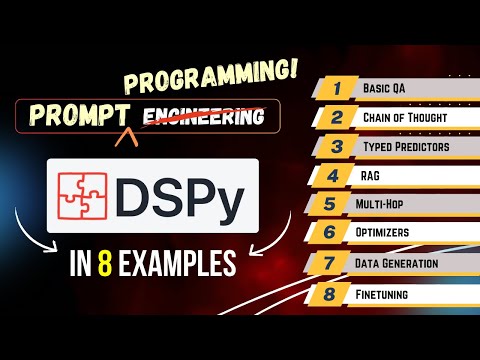
DSPy (review) video
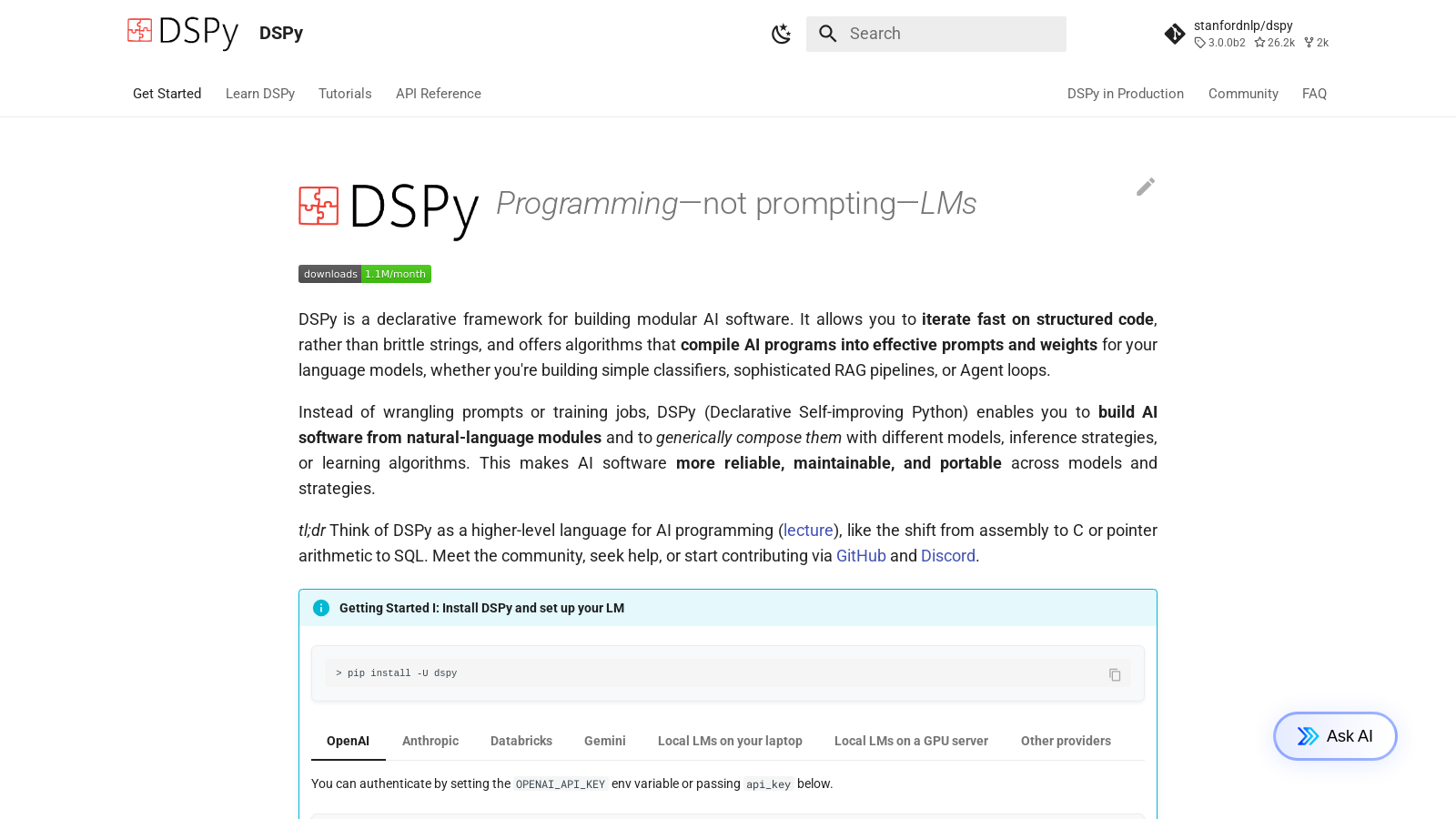
Screenshot of DSPy
What is DSPy?
DSPy (Declarative Self-improving Python) is an advanced framework designed to streamline the development of AI software. The core principle of DSPy is to shift from the often cumbersome task of crafting prompts for AI models to a more modular and structured coding approach. This evolution mirrors the transition from lower-level programming languages, such as assembly, to more expressive high-level languages like C or SQL. By doing so, DSPy enhances the reliability and portability of AI applications, allowing for quick iterations and adaptations in response to changing requirements.
Among the many standout features of DSPy is its capability to compile AI programs into effective prompts and weights tailored for various language models. Rather than getting bogged down in prompt management or lengthy training processes, developers can focus on constructing flexible, modular systems that readily adapt to different models and strategies. This design paradigm not only promotes flexibility but also significantly improves the maintainability of AI software, freeing developers from cumbersome string manipulations in favor of intuitive natural-language modules.
Getting Started with DSPy
To initiate your journey with DSPy, the first step is to install the package via pip:
pip install -U dspy After installation, developers can effortlessly set up their language model and start creating their AI systems using a straightforward API. This API is designed to be both simple enough for newcomers to grasp quickly, while still offering a robust toolkit for seasoned developers. With this streamlined API, users can rapidly develop and test a range of AI applications, from straightforward classifiers to sophisticated retrieval-augmented generation (RAG) systems.
Building Modular Systems
Once DSPy is installed, users can create custom modules specific to their tasks. These modules allow developers to define both the input and output behaviors of their AI systems. The framework provides a diverse array of modules, including components for mathematical challenges, classification tasks, information extraction, as well as more intricate multi-stage systems.
Example Module: Chain of Thought
The Chain of Thought module exemplifies DSPy’s strengths by structuring reasoning processes to yield more coherent outputs. Developers can define a clear signature for this AI component, guiding input expectations and anticipated responses, ultimately ensuring clarity and precision in the outputs generated by the language model.
Optimizers: Enhancing AI Performance
A significant feature of DSPy is its built-in optimizers, which facilitate the tuning of both prompts and weights to enhance the performance of AI modules. These optimizers adapt to numerous input types and feedback, providing a flexible and iterative mechanism for refining AI system outputs. Each optimizer, like the generalized experimental RL, integrates seamlessly with various input contexts, allowing for tailored adaptations based on the intricacies of the task at hand.
The DSPy Community and Ecosystem
Since its inception at Stanford NLP in early 2022, DSPy has cultivated a vibrant community dedicated to open-source AI research. With collaborative efforts leading to continuous improvements, developers are not only contributing code but are also enriching the framework with invaluable knowledge and resources. Tutorials, best practices, and innovative optimization techniques are among the many outputs from this dynamic community.
This community-driven approach allows DSPy users to harness a wealth of resources, promoting accelerated iteration and the implementation of cutting-edge advancements in AI research. The support from the community fosters an environment where developers are encouraged to share insights and enhancements, further fueling the evolution of DSPy.
Conclusion
In summary, DSPy emerges as a powerful framework for crafting AI solutions that emphasize modularity, user-friendliness, and adaptability. Whether you are a novice eager to dive into AI programming or an experienced developer looking to optimize complex workflows, DSPy provides a robust and engaging environment for developing innovative AI systems.
Pros & Cons
Pros
- Enables fast iteration on AI software through structured code instead of brittle prompts.
- Supports modular AI design, enhancing reliability and maintainability across models.
- Automates prompt optimization and weight adjustments, streamlining AI program performance.
Cons
- Requires familiarity with programming concepts for effective use, limiting accessibility.
Frequently Asked Questions
DSPy is open source and free to use.
According to our latest information, this tool does not seem to have a lifetime deal at the moment, unfortunately.
DSPy is versatile and can be used to build a variety of AI solutions, such as simple classifiers, sophisticated RAG (Retrieval-Augmented Generation) pipelines, and agent loops. You can create modules for tasks such as math reasoning, information extraction, classification, and multi-stage pipelines, enabling a wide range of applications in your AI development.
To optimize your DSPy models, you can utilize various built-in optimizers, such as MIPROv2 or BootstrapFewShot. These optimizers help tune the prompts and weights of your AI modules by synthesizing examples and refining instructions based on performance metrics. By running these optimizers, you can significantly enhance the accuracy and efficiency of your AI systems.
Yes, DSPy is compatible with various language models, including those from OpenAI, Anthropic, and local LMs. You can set up an LM in DSPy by using the 'dspy. LM' class and providing your model name along with an API key, like this: 'lm = dsp. LM 'y.LM("openai/gpt-4o-mini", api_key="YOUR_OPENAI_API_KEY"). This enables you to integrate different models into your AI applications easily.
To get started with DSPy, you first need to install it using pip by executing 'pip install -U dspy'. After installation, you can configure your language model, create modules for various tasks, and start building AI pipelines. It's recommended to follow the learning path provided in the tutorials on the official DSPy website for structured guidance during your initial development.
In DSPy, if you encounter 'context too long' errors, it typically means that the prompts generated are exceeding the model's context window. You can mitigate this by reducing parameters such as max_bootstrapped_demos or retrieved documents. Additionally, you can increase the max_tokens specified in the LM request to prevent such errors, allowing for more comprehensive responses.
DSPy provides a higher-level programming paradigm by integrating structured, declarative modules that enhance reliability and reduce complexity. Unlike other frameworks that focus on prompt engineering, DSPy enables the dynamic composition and optimization of modules, making it an ideal choice for robust AI development. It also fosters an open-source community that continuously evolves and contributes to the framework's capabilities.
You can easily create custom metrics in DSPy by defining them as Python functions that take model outputs and return scores. For example, you can write a function that evaluates the quality of predictions against ground truth labels. These custom metrics can then be utilized during the evaluation and optimization processes, providing tailored feedback for your AI systems.
DSPy offers a variety of resources for learners, including comprehensive tutorials, API references, and a dedicated FAQ section on its website. Additionally, you can join the DSPy community on platforms like GitHub and Discord to seek help, share experiences, and collaborate with other developers. This community engagement can facilitate troubleshooting and enhance your learning journey.