












Galileo

Platform that provides proactive monitoring and evaluation for generative AI applications
Galileo.ai
Is this your tool?
Follow for updates & deals
Get alerts for Galileo discounts, feature releases & pricing changes
Similar Tools

CodeWiki
Automatically updates code documentation and provides AI-driven Q&A support for developers.
Reliable AI
Facilitating practical AI solutions bridging research in legal and academic fields.

Zhipu
Develops AI models that replicate human cognitive processes for improved machine interaction.

Promptmonitor
Monitor brand mentions across various AI platforms to enhance visibility and marketing strategies.

Z.ai
Generates professional presentations, assists in writing tasks, and supports coding projects with AI.

Galileo Media Gallery

Galileo (review) video
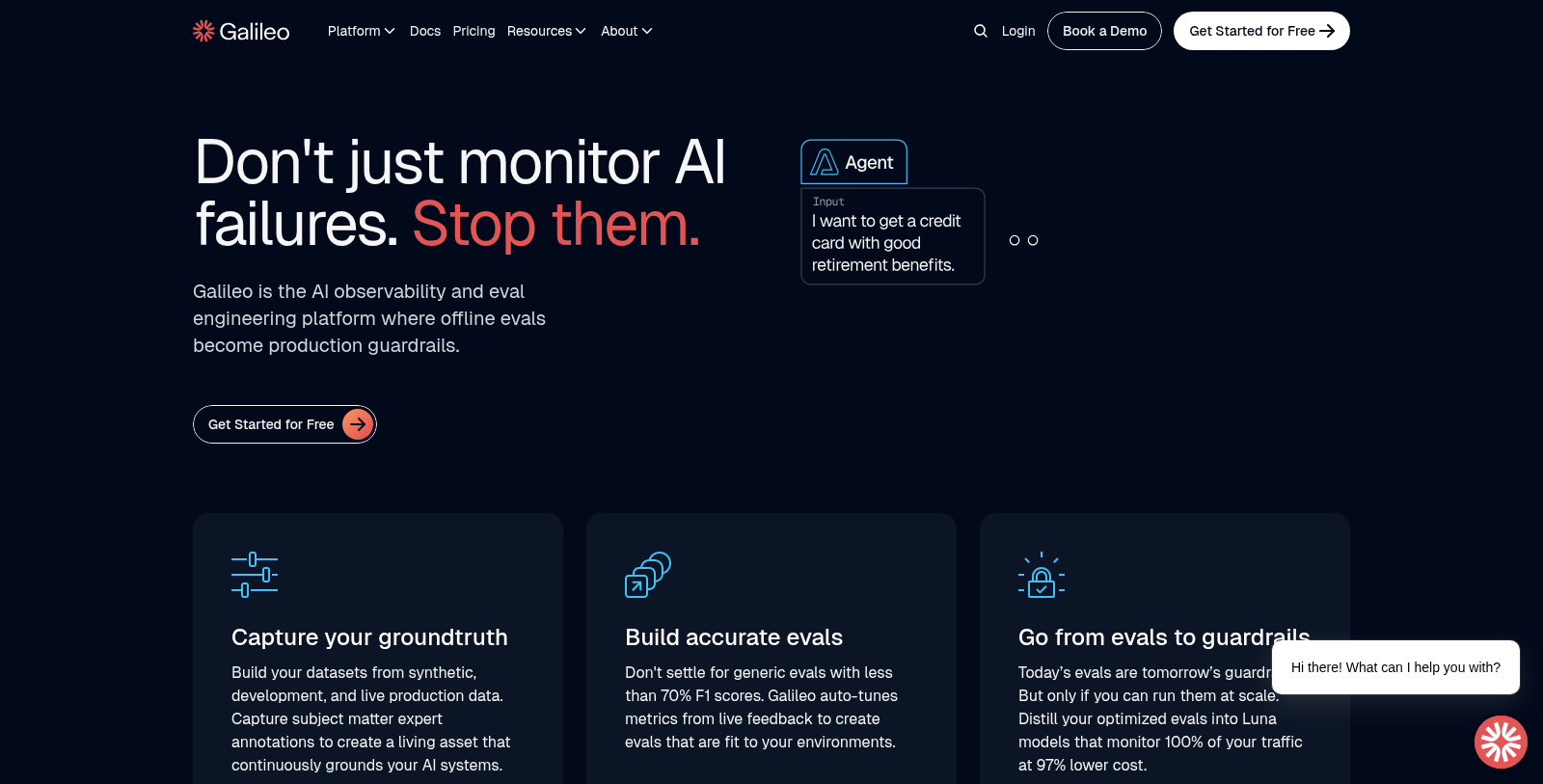
Screenshot of Galileo
What is Galileo?
Galileo is an innovative AI observability and evaluation platform designed to empower AI teams to monitor, evaluate, and protect generative AI applications at scale. In an age where AI systems can quickly become complex and unpredictable, Galileo stands out by providing essential insights that facilitate continuous improvement and dependable user experiences.
One of the core features of Galileo is its emphasis on proactive monitoring. Unlike traditional systems that log failures after they occur, Galileo helps teams anticipate issues before they impact users. With a comprehensive set of out-of-the-box evaluations, teams can assess their AI's performance as it develops, reducing the risk of unexpected behavior in production.
Galileo streamlines the evaluation process with its ability to compile various metrics. Users can capture data across multiple environments, including synthetic, development, and live production setups. Moreover, subject-matter expert annotations enhance dataset quality and provide vital feedback loops essential for successful AI deployment.
The platform's auto-tuning capabilities ensure that evaluation metrics are continually optimized based on real-time performance feedback—this means organizations don't need to settle for generic evaluation standards. By leveraging advanced machine learning models, Galileo turns raw data into actionable insights, identifying risk factors such as hallucinations in AI output, which can lead to costly operational errors.
Why Choose Galileo?
Teams that adopt Galileo benefit from its tailored evaluations designed for a wide range of AI applications, from chatbots to autonomous agents. The platform's architecture efficiently handles large volumes of data, enabling organizations to move fast while ensuring quality and compliance.
Deep Insights for Continuous Improvement
Galileo goes beyond basic monitoring by offering advanced insights into the AI development lifecycle. Its insights engine analyzes agent behavior to surface hidden patterns and recommend corrective actions, allowing developers to focus on building robust systems tailored to specific business needs.
Cost-Effective AI Solutions
Utilizing small language models (SLMs), such as the Luna family, Galileo provides a cost-effective route for real-time evaluations and guardrails. The models operate with low latency while maintaining high accuracy, allowing enterprises to scale their AI applications without incurring prohibitive costs typically associated with expansive LLMs.
In addition to being easy to integrate with existing workflows, Galileo simplifies compliance management with its advanced metrics and logging capabilities, ensuring that organizations can adhere to industry standards while maintaining operational efficiency.
Conclusion
As AI technologies continue to evolve, relying solely on traditional monitoring methods is no longer viable. Galileo represents a holistic approach to AI evaluations, fortifying systems against failure and ensuring they can adapt to dynamic user requirements. Developers can confidently advance their AI applications, knowing they have a reliable partner in Galileo.
Pros & Cons
Pros
- Offers real-time monitoring and guardrails to prevent AI failures and improve reliability.
- Utilizes auto-tuning metrics to enhance evaluation accuracy tailored to specific environments.
- Integrates seamlessly into the AI development lifecycle, providing an end-to-end evaluation solution.
Cons
- Complexity may increase for teams new to evaluating and monitoring AI systems.
Frequently Asked Questions
Galileo is free to start, with paid plans from 0 to 100 USD per month.
According to our latest information, this tool does not seem to have a lifetime deal at the moment, unfortunately.
Galileo enables you to perform a range of evaluations across domains, including Retrieval-Augmented Generation (RAG), agent evaluations, and safety and security assessments. With over 20 out-of-the-box evaluators and the ability to create custom ones, you can tailor assessments to your specific needs. This flexibility allows you to build evaluators tailored to your environment, enabling you to monitor performance effectively and continuously improve your AI systems.
Galileo addresses AI failures through its Insights Engine, which automatically analyzes agent logs and metrics to identify failure modes. This shift from reactive debugging to proactive identification enables you to surface root causes and receive specific recommendations for improvement quickly. These capabilities include instant failure recognition, adaptive insights, and actionable root-cause analysis, allowing the developers to debug and enhance their AI systems efficiently.
Luna models are Galileo's family of small language models designed for low-cost, high-speed evaluation. These models enable real-time monitoring and guardrails for AI systems, enabling assessments with millisecond-level verdicts at a significantly lower cost than traditional LLMs. With Luna models, you can conduct simultaneous evaluations across multiple metrics, efficiently managing your production workflows while maintaining high accuracy.
Galileo enhances AI application deployment by integrating continuous evaluation and observability throughout the development lifecycle. By providing tools for real-time monitoring, debugging, and guardrailing, teams can catch potential failures before they affect users. The platform also supports A/B testing, CI/CD processes, and rapid iteration based on real user experiences, collectively helping teams ship reliable AI applications faster.
Yes, Galileo offers flexible deployment options, including SaaS, Virtual Private Cloud (VPC), and on-premises setups. This flexibility allows organizations to choose the environment that best fits their security requirements and operational protocols. Whether you prefer cloud-based solutions or on-site implementations, Galileo can cater to your infrastructure preferences.
Galileo includes several measures for safety and security, such as its Protect feature, which serves as a real-time hallucination and threat firewall. This system intercepts risky inputs and outputs before they impact users, utilizing Luna models to score every interaction against advanced guardrail metrics. Users can define specific rules to handle breaches, ensuring that applications remain secure and operationally sound.
Galileo fosters collaboration through its shared environment that allows multiple users to access tools and resources. With features like unlimited users on the free plan, dedicated support in the Pro version, and customizable metrics, teams can work together effectively. The platform's auto-tuning capabilities and continuous feedback loops also enable collaborative improvement on evaluations, ensuring all developers can contribute to enhanced performance.
Galileo provides various support options depending on the subscription plan. Users on the Free Plan can access basic community support, while the Pro Plan offers standard Role-Based Access Control (RBAC), advanced analytics, and dedicated support via Slack. For enterprises, a custom plan is available that includes 24/7 support via email, phone, or Slack, as well as forward-deployed engineering support tailored to specific organizational needs.