











Gretel

Generate synthetic datasets for AI applications while ensuring data privacy and compliance.
Gretel.ai
Is this your tool?
Follow for updates & deals
Get alerts for Gretel discounts, feature releases & pricing changes
Similar Tools

Wayve
Automated driving solution utilizing AI for safe and adaptable navigation without reliance on HD maps.

TensorZero
Streamlines integration and optimization of large language models for industrial applications.

Promptfoo
Evaluate and secure large language model applications with an open-source command-line interface.

Sliq
Automated data cleaning for better data analysis.
NetMind
Integrate and optimize AI models using a range of APIs and scalable GPU clusters.

Gretel Media Gallery

Gretel (review) video
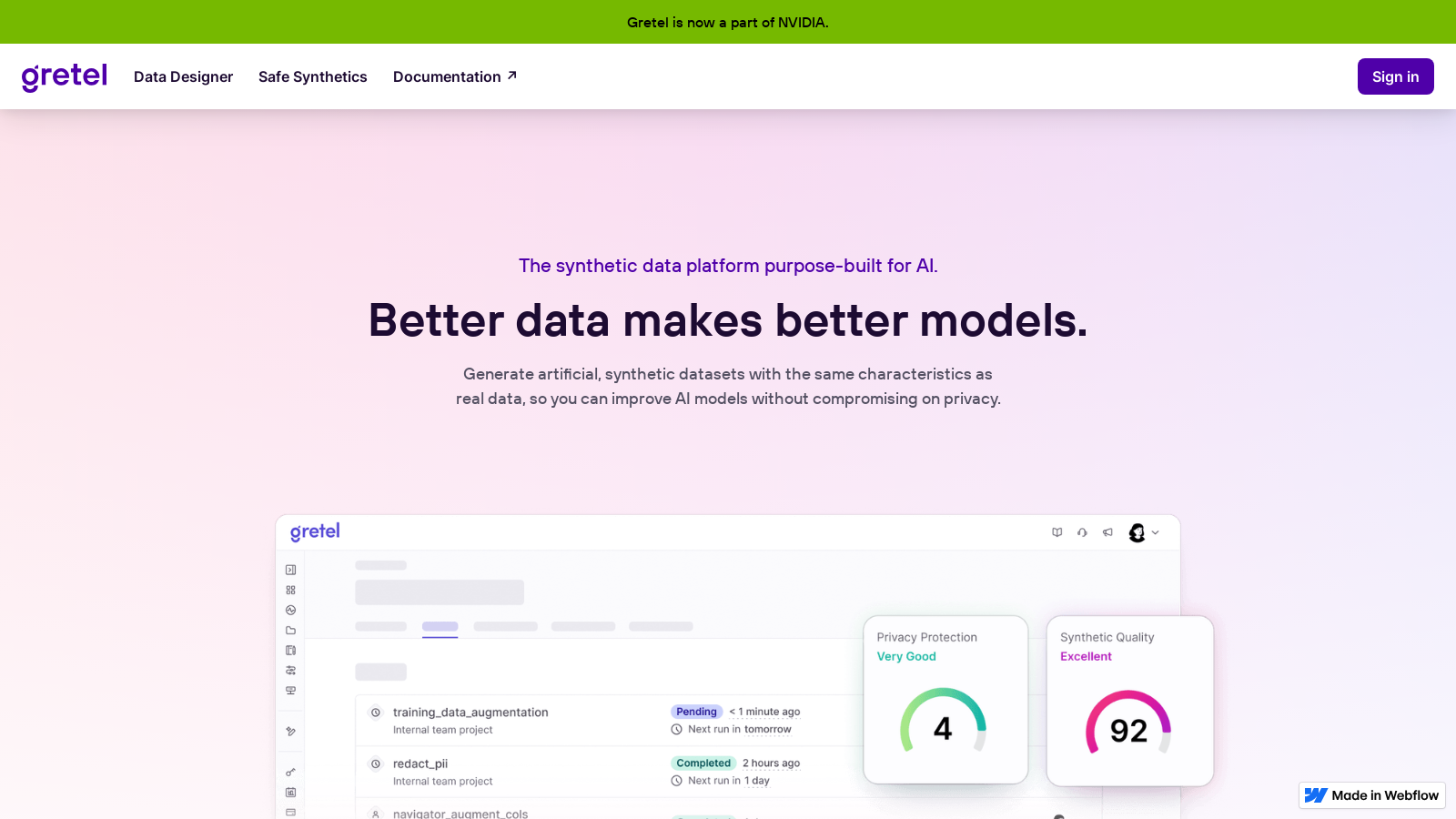
Screenshot of Gretel
What is Gretel?
Gretel is a groundbreaking platform that specializes in generating synthetic data tailored for artificial intelligence applications. Acquired by NVIDIA, Gretel is designed to empower developers to create artificial datasets that mimic the characteristics of real data, thereby enhancing AI model performance without sacrificing user privacy. The platform is versatile, offering tools and APIs for developers to create, validate, and generate synthetic data quickly and efficiently.
One of the key offerings from Gretel is the Gretel Data Designer. This tool is a comprehensive solution for building datasets with an emphasis on data-centric AI. It enables developers to specify the desired attributes of the datasets they wish to create, generating accurate, contextually relevant synthetic data effortlessly. The ability to preview generated datasets in real-time accelerates the development process, saving valuable time for AI model training.
Features of Gretel
Gretel stands out due to its user-focused features:
- Speed: The platform enables the generation of preview datasets in minutes, moving from proof-of-concept to production quickly.
- Quality: Built-in evaluation metrics help ensure the accuracy and relevance of the generated data, which is critical for effective machine learning.
- Simplicity: Gretel streamlines synthetic data workflow through automated processes, making it easier for developers to implement.
- Scale: Thanks to its robust infrastructure, Gretel can accommodate a growing need for synthetic data without requiring a complete overhaul of systems.
- Privacy-First Approach: By applying privacy principles like GDPR and HIPAA, Gretel ensures that sensitive data remains protected while still enabling accurate data modeling.
Getting Started with Gretel
Developers can begin using Gretel by signing up for a free account on their website. After setting up their environment and retrieving an API key, users can start creating synthetic datasets immediately. Gretel's console provides a user-friendly interface for generating data from existing datasets or through prompts, eliminating the need for extensive coding knowledge.
Use Cases
Gretel is equipped with various use case examples and blueprints that help users understand how to utilize synthetic data effectively across diverse scenarios:
- Creating GDPR-compliant customer datasets.
- Synthesizing healthcare data while adhering to HIPAA requirements.
- Building test datasets for development or training data for AI models.
These examples serve as a guide for developers to customize Gretel for their specific needs, making the platform highly adaptable and functional.
Conclusion
In a world where data privacy is paramount, Gretel emerges as a vital tool for developers looking to harness the power of synthetic data. By offering a complete suite of features designed to simplify data generation while maintaining robust privacy protections, Gretel not only enhances AI model performance but also aligns with current regulations on data use.
Pros & Cons
Pros
- Generate high-quality synthetic datasets on demand to improve AI models.
- Simple APIs and a user-friendly interface facilitate rapid development and integration.
- Built-in evaluation metrics ensure the accuracy and relevance of generated data.
Frequently Asked Questions
Gretel is open source and free to use.
According to our latest information, this tool does not seem to have a lifetime deal at the moment, unfortunately.
With Gretel's Data Designer, you can create various types of synthetic datasets tailored to your needs. You can generate datasets for AI model training, structural outputs, multi-turn chat dialogues, code generation (in Python and SQL), and even evaluation datasets for systems like Retrieval-Augmented Generation (RAG). The platform also allows you to introduce demographic diversity by creating datasets with realistic personal details.
Gretel prioritizes data privacy through its Safe Synthetics feature, which enables the development of synthetic datasets that comply with regulations such as GDPR and HIPAA. It ensures that sensitive information is transformed into realistic synthetic equivalents while maintaining the data's analytical utility. This enables organizations to leverage valuable data without compromising the exposure of personally identifiable information.
Gretel provides simple APIs that allow developers to generate synthetic data programmatically. These APIs facilitate the anonymization of existing data, labeling of personally identifiable information, and creation of large datasets without manual intervention. Developers can integrate these capabilities into their applications to accelerate development and enhance the quality of AI models while preserving privacy.
Yes, Gretel's services can be run in both its managed cloud service and within your private cloud environment. This flexibility allows organizations to maintain control over their data while still leveraging Gretel's powerful synthetic data generation capabilities. This is particularly beneficial for businesses that must comply with stringent data governance and privacy policies.
Gretel offers a comprehensive Quickstart guide that walks you through the installation process, including how to set up your account and retrieve your API key. Additionally, the platform provides Use Case Examples and Blueprints to help you explore common scenarios and adapt them for your projects. For further assistance, users can access detailed documentation and example notebooks.
The Magic library in Gretel's Data Designer is a feature designed to accelerate the development of synthetic datasets. It provides LLM-generated prompts, categories, and configurations that streamline the dataset creation process. This tool empowers developers by automating aspects of dataset generation, allowing for more efficient experimentation and iteration on data-driven projects.
While Gretel supports the generation of various types of synthetic data, the specifics of what can be synthesized may depend on your use case and the configurations you set in the Data Designer. It's advisable to consult the detailed documentation and try out example notebooks to understand any constraints for specific types of data you aim to generate, such as specialized formats or complex data relationships.
Gretel includes built-in evaluation metrics that help you validate the quality and relevance of the synthetic data you generate. Users can assess their datasets against specific criteria and privacy scores to ensure the synthetic data meets the necessary standards for their application. This validation process is crucial in confirming that the generated data is suitable for training AI models and other data-driven initiatives.