











Julius

Analyze and visualize data using natural language for clear insights and reports.
Julius.ai
Is this your tool?
Follow for updates & deals
Get alerts for Julius discounts, feature releases & pricing changes
Similar Tools

Maitai
Optimizes large language model requests for speed, accuracy, and lower latency in enterprise AI applications.

Validate Idea
Test and validate startup ideas by creating customizable landing pages for user feedback.

Fundable
Access real-time insights and data on startups and investors for informed decision-making.

Perplexity
Provides real-time market data analysis and community-driven finance insights for informed investment decisions.

Clearitty
Provides real-time market insights and lead scoring to optimize sales processes and improve deal closure rates.

Julius Media Gallery

Julius (review) video
Screenshot of Julius
What is Julius?
What is Julius
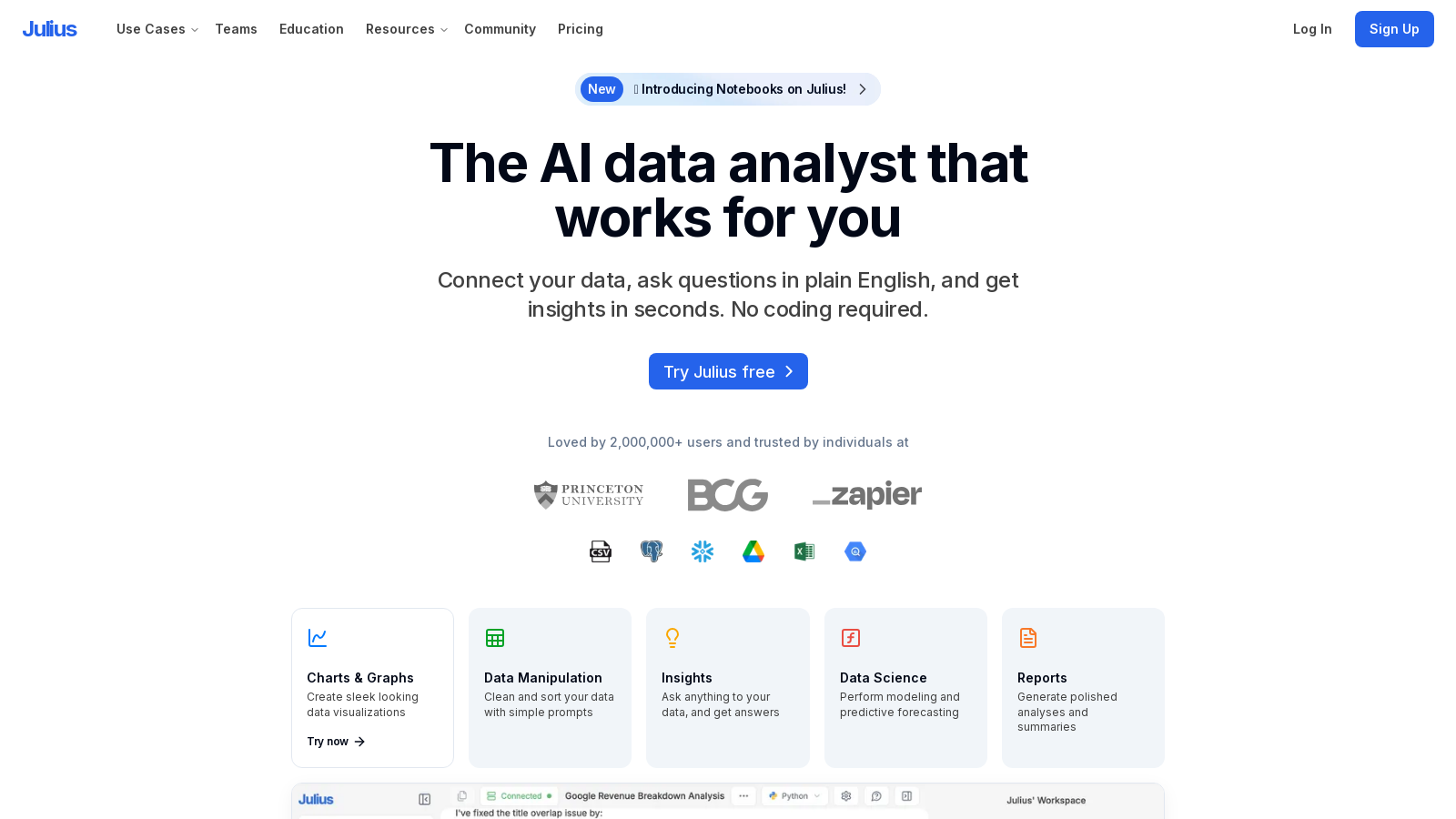
Julius is a powerful AI data analyst that transforms how users—from individuals to enterprises—interact with their data. This advanced platform provides tools for the analysis, visualization, and extraction of deep insights from complex datasets. With robust artificial intelligence and natural language processing capabilities, Julius democratizes sophisticated analytics, making it accessible to users of all experience levels. Now trusted by over 2 million users, Julius enhances data-driven decision-making across various sectors, including finance, marketing, education, and scientific research.
Introducing Notebooks:
The newly launched Notebooks feature empowers users to craft, share, and modify custom workflows tailored to specific analytical tasks. This functionality fosters enhanced collaboration, offering diverse templates that streamline the data analysis process. Users can also request personalized notebook templates, improving their workflow flexibility even further. Notebooks allow for job-specific workflows, making data processing more intuitive and efficient. This innovation positions Julius as a versatile tool for various job roles, making data analysis easier and more effective for users.
Key Features:
- Data Analysis: Julius accommodates a wide spectrum of file formats, including CSV, XLSX, PDFs, and images. Users can engage with their data through natural language queries, receiving immediate analyses and customized reports, effectively transforming data exploration into a conversational process. With a user-friendly interface, the platform allows users to interact effortlessly with their datasets.
- Data Manipulation: The platform simplifies data preparation, allowing users to clean, merge, and sort data effortlessly. Intuitive commands enable users to transition swiftly from data preparation to analysis and reporting, significantly reducing time and effort.
- Visualization: Julius empowers users to create aesthetically appealing graphs, charts, and summaries that effectively convey intricate insights. Creating polished, digestible visual content has never been easier.
- Predictive Modeling: Users can easily construct predictive models to anticipate trends and customer behaviors—an essential feature for businesses eager to remain agile and competitive. The platform supports advanced model options, including integration with machine learning frameworks, enhancing its predictive capabilities.
- Real-time Collaboration: The interactive notebooks feature allows multiple users to collaborate on analyses in real-time, boosting productivity and promoting teamwork within organizations.
- Instant Insights: Julius is designed for rapidity, providing insights in seconds rather than hours. This quick turnaround accelerates the analytics process, enabling prompt decision-making when it counts the most.
- Comprehensive File Support: The platform supports numerous file types, including CSV, XLSX, PDFs, and various image formats, enhancing its adaptability for different analytical tasks.
How to Get Started:
Starting with Julius is easy. Users can register for a free account, which grants access to a limited number of messages each month, allowing them to experiment with the platform's capabilities. For users looking to enhance their experience, Julius offers tiered subscription plans that cater to both teams and enterprises.
The Plans:
- Free Plan: Ideal for individuals engaged with smaller projects, this plan allows for up to 15 messages per month at no charge, providing an excellent opportunity to explore Julius' functionalities.
- Plus Plan: Priced at NULL.67/month (billed annually), this tier includes up to 250 messages per month, AI customization options, and advanced reasoning features, tailored for professionals needing prompt insights.
- Pro Plan: Priced at NULL.50/month (billed annually), this plan features unlimited messaging and robust collaboration tools, designed for organizations requiring advanced data analysis capabilities.
- Enterprise Plan: Customized for organizations with specific needs, this plan includes dedicated deployments, bespoke integrations, and priority support; users can contact Julius for tailored pricing and proposals.
New Additions: Julius now offers enhanced security controls, customizable user roles in its subscription plans, and compliance with standards like SOC 2 Type II and GDPR. This commitment to data security means users can trust that their data is safeguarded with advanced encryption and strict access controls, maintaining confidentiality and integrity throughout their analytical processes. Additionally, users can leverage AI capabilities to produce visualizations quickly, improving the clarity and impact of their reports.
With its intuitive interface and powerful analytical functionalities, Julius is an indispensable tool for anyone looking to elevate their data analysis proficiency. The platform's versatility renders it suitable for a multitude of business operations and scientific inquiries, establishing itself as a vital asset across multiple industries.
Conclusion:
Julius transcends the traditional role of a data analysis tool; it serves as an essential partner for a diverse range of users, from students to seasoned professionals. By simplifying engagement with data and delivering reliable advanced analytics, Julius empowers users to convert their data into actionable insights effortlessly. Whether for academic research, business analysis, or informed decision-making, Julius provides the critical tools necessary for achieving impactful results.
Pros & Cons
Pros
- Integration of advanced AI models like GPT-4 and Claude enhances analysis capabilities.
- Users can manipulate data with simple prompts and receive instant insights.
- Versatile application for various industries, including finance, education, and research.
Cons
- Proper data formatting is required for accurate analysis, which may be a limitation for some users.
Frequently Asked Questions
Julius is available at no cost.
According to our latest information, this tool does not seem to have a lifetime deal at the moment, unfortunately.
Julius supports a wide variety of data sources, including but not limited to spreadsheet files (.xls, .xlsx, .csv), Google Sheets, images (.jpeg, .png), PDFs, and text-based files (.docx, .txt). You can drag and drop your data files into the platform for analysis, making it highly versatile for various file formats.
Yes, Julius can analyze spreadsheets with multiple tabs. When you upload your multi-tab spreadsheet, you can refer to the individual tab names in your prompts. Julius will perform the analysis based on the specified tab, allowing for a seamless transition between datasets within a single file.
To ensure optimal analysis, your data should be well-organized and structured. Use descriptive column headers in the first row, avoid empty rows or columns, and ensure there are no multiple tables within the same file. Following these guidelines will facilitate accurate data processing by Julius. For detailed formatting instructions, check Julius' data formatting guide.
Julius can provide expert-level insights by allowing you to ask questions about your data. You can receive answers in the form of summarized reports, graphs, and tables. It effectively facilitates predictive modeling and can even suggest actions based on your analysis, streamlining the decision-making process.
Julius is designed to aid educators and students by simplifying complex data analysis concepts. Teachers can create workflows for lessons, and students can interact with data using natural language commands. This functionality demystifies statistical processes, allowing students to focus more on insights rather than data syntax.
Absolutely! Julius is particularly beneficial for research environments where data analysis is complex and requires advanced tools. It allows researchers to extract p-values, run regression models, and automate data processing tasks with ease. Additionally, it offers detailed statistical explanations, making it easier to understand results and methodologies.
To maximize your results with Julius, interact with it like a research assistant by giving clear, step-by-step instructions. Ensure your data is correctly formatted as per our guidelines, and don't hesitate to refine your queries if you're not satisfied with the responses. Using the provided operational tips and visiting the guides section can also enhance your experience.
Julius places a strong emphasis on data privacy and security. Each user has access to their data through secure notebook storage, and once data is deleted, it is erased from the servers. The platform also employs strict access control measures, ensuring that even code execution environments are sandboxed for enhanced security.