











Letta

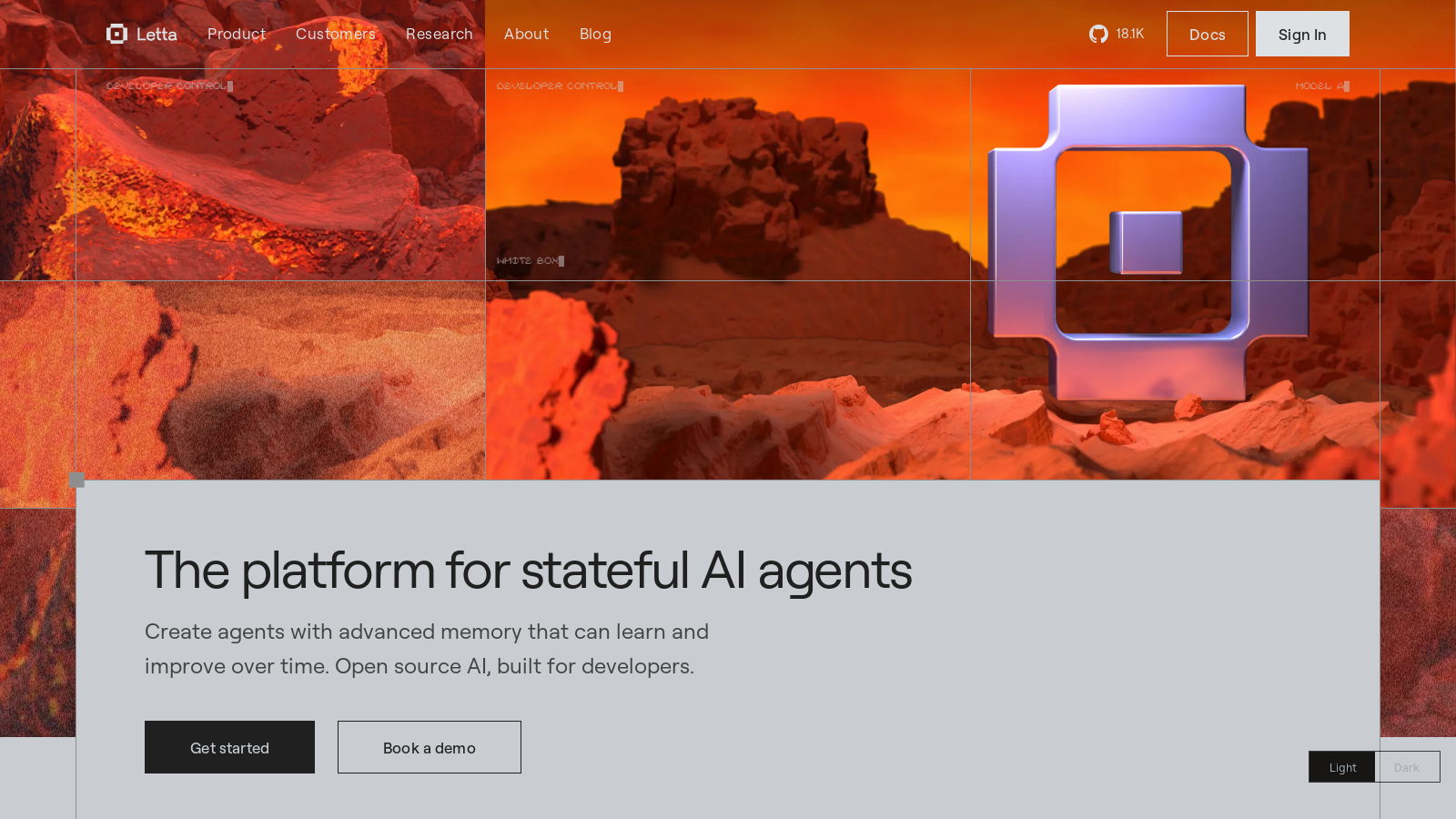
Build and manage stateful AI agents with advanced memory capabilities for enhanced interaction.
Letta.com
Is this your tool?
Follow for updates & deals
Get alerts for Letta discounts, feature releases & pricing changes
Similar Tools

Browser Use
Automate web task management, including sessions and files, with user-friendly browser automation features.

Kimi K2 AI
An open-source chatbot platform designed for efficient task automation and advanced AI solutions.

Forefront
Fine-tune and deploy open-source language models with customizable options for various AI applications.

Qwen3-Coder
A code model that enhances coding tasks through agentic interactions and extensive context handling.

LangChain
A framework for building and deploying applications powered by large language models.

Letta Media Gallery

Letta (review) video
Screenshot of Letta
What is Letta?
Letta is an innovative platform designed for developers seeking to create stateful AI agents that possess advanced memory, enabling them to learn and evolve. This framework leverages a unique Agent Development Environment (ADE), empowering the development process with tools and functionalities that dramatically enhance agent capabilities. Instead of leading to the stagnation often observed in traditional models, Letta employs a unique memory management system backed by academic research from notable researchers at UC Berkeley's Sky Computing Lab. With Letta, developers can focus on crafting agents that can adapt, reason, and remember throughout their operational lifetime.
One of the standout features of Letta is its emphasis on built-in persistence and memory management. Developers will appreciate how this framework enables them to seamlessly transition their agents between different language models while retaining the learned context and memory. This model-agnostic approach not only enhances the flexibility of the agents but also mitigates the challenges typically associated with vendor lock-in. Letta's API further facilitates this connectivity, ensuring that agents are exposed as REST endpoints that can be easily integrated into existing applications.
Advancing Agent Intelligence
Letta is geared towards making the future of AI more accessible and functional through the development of intelligent agents that recall past interactions. Agents built with Letta are designed to evaluate and enhance their performance over time through interactions, becoming smarter as they engage with users. This is accomplished through context management techniques designed to enhance the effectiveness and reliability of memory—the foundation of intelligent decision-making.
Agent Development Environment (ADE)
The ADE provides a visual workspace where developers can observe and iterate on the memory, reasoning paths, and tool calls of their agents in real time. This feature not only aids in debugging but also helps developers understand how context is passed into the AI models. Additional recent features enhance this experience, allowing for better refinement and visualization of the agent's interactions.
Robust API Support and Integration
Letta's API support is comprehensive, allowing developers to use various SDKs in different programming languages such as Python and TypeScript. This versatility simplifies the implementation of stateful agents into diverse applications, capitalizing on the unique capabilities that Letta offers. The platform has introduced new client SDKs that enhance usability for developers while streamlining the integration process, making it easier than ever to leverage Letta's features.
Open Source Advantages
As an open-source platform, Letta is readily accessible to developers across the globe. It encourages collaborative enhancement of features and functionalities, aligning with the belief that the future of AI development should be inclusive and open to innovation. The community-driven approach not only fosters rapid advancements but also enables developers to share their solutions and refine their practices. With Letta, developers gain access to foundational research, including techniques developed by the team behind MemGPT, ensuring cutting-edge capabilities.
Innovative Features and Tools
Letta provides developers with innovative tools like the Letta Filesystem, which allows agents to organize and reference content from various document types, including PDFs and transcripts. This feature enhances the agents' ability to recall and utilize information effectively, thereby expanding their utility in real-world scenarios. Additionally, Letta's new capabilities include advancements in agent memory and learning through sleep-time compute, an approach that allows agents to continue processing and refining their memory during idle periods.
Benchmarking and Performance
Letta emphasizes performance, with benchmarks revealing that agents utilizing its memory management techniques outperformed traditional models on tests such as Terminal-Bench and the newly introduced Recovery-Bench. These metrics illustrate how effectively agents recover from errors and adapt to complex tasks, showcasing Letta's advanced capabilities in real-world application settings. Recent developments have included evaluations that measure how well agents can learn from context pollution, emphasizing the platform's ongoing commitment to improvement.
Conclusion
With Letta, developers are no longer limited to static models but can craft dynamic, evolving agents that possess the ability to remember, learn, and improve after every interaction. The suite of tools, functionalities, and the developer-centric approach provided by Letta sets a new standard in the realm of AI agents, paving the way for more intelligent application scenarios across myriad industries. The focus on open-source collaboration, research-backed memory management, powerful integrations, and concepts such as sleep-time compute make Letta a front-runner in the field of stateful AI systems.
Pros & Cons
Pros
- Stateful agents maintain memory and context across interactions, enhancing learning.
- Built-in Agent Development Environment allows for real-time visualization and testing.
- Flexible framework supports multiple programming languages and tools for integration.
Frequently Asked Questions
Letta is available at no cost.
According to our latest information, this tool does not seem to have a lifetime deal at the moment, unfortunately.
The Agent Development Environment (ADE) is a visual tool that allows developers to create and manage stateful AI agents. It enables users to visualize an agent's memory, reasoning processes, and tool interactions in real time. This facilitates testing and editing of an agent's state within a user-friendly interface, making the development process more intuitive and helping developers understand the context and decisions made by their agents.
Letta Cloud provides a fully managed service for deploying stateful agents, eliminating the need for infrastructure management. To deploy agents, you need to create an API key to access the service. The platform ensures high availability and performance, allowing you to handle large-scale deployments seamlessly. It also supports the migration of agents between cloud and self-hosted environments while maintaining their state and history.
Letta supports integration with various development frameworks and tools through its REST API and SDKs. Integrations include popular frameworks such as Python and TypeScript SDKs, as well as others like Next.js and React. You can connect Letta agents to various external tools via the Model Context Protocol (MCP), which enhances the agents' functionality by allowing them to utilize additional resources and capabilities from the integrated tools.
Yes, Letta is designed to create stateful agents that can learn and remember from past interactions. It utilizes advanced memory management techniques to persist the agent's state across sessions, so the agents don't forget previously learned information. This enables more intelligent and personalized interactions over time, as agents continually improve based on their previous experiences and can adjust their responses accordingly.
Recovery-Bench is a benchmark developed by Letta to evaluate how well AI agents can recover from errors and learn from past mistakes. This is crucial for long-lived agents, as they often make mistakes during complex tasks. By assessing agents' abilities to manage and recover from context pollution—where earlier errors affect their performance—Recovery-Bench provides insights into the resilience of different models, ultimately helping in the development of more robust AI agents.
Letta implements a unique memory management structure inspired by traditional operating systems, enabling agents to manage context and retain information over prolonged interactions actively. Unlike many AI systems that have limited context lengths, Letta's architecture allows agents to maintain a memory hierarchy, including core memory for active sessions and external memory for conversation history, which can be recalled as needed. This approach significantly reduces issues like forgetfulness and errors in long-running tasks.
While Letta provides powerful tools for building stateful AI agents, developers may encounter challenges related to adapting existing code to work with Letta's architecture, especially when transitioning from traditional stateless models. Additionally, extensive knowledge of memory management and context handling is required to maximize the effectiveness of agents. The documentation is continuously updated, so users are encouraged to consult the official resources for best practices and the latest information.
Yes, Letta features several case studies showcasing its effectiveness in real-world applications. For instance, Bilt successfully built a million-agent recommendation system using Letta, demonstrating how memory-augmented agents can personalize user experiences at scale. Other examples include 11x, which created deep research agents in record time, and Hunt Club, which streamlined executive recruitment processes. These case studies illustrate the practical benefits of utilizing Letta for developing sophisticated AI agents.