











LibreCrawl
Open-source SEO crawler offering unlimited URL audits and JavaScript rendering without licensing fees.
Librecrawl.com
Is this your tool?
Follow for updates & deals
Get alerts for LibreCrawl discounts, feature releases & pricing changes
Similar Tools

AlsoAsked
Keyword research tool that uncovers user queries from Google's People Also Ask section
Screaming Frog SEO Spider
Crawls websites to identify technical SEO issues and analyze page performance.

Yext
Manage business information across digital channels for multi-location brands.

SE Ranking
All-in-one SEO software for keyword tracking, backlink analysis, and reporting.

Adapty
Optimize in-app purchase revenue with flexible paywall management for mobile app developers.

LibreCrawl Media Gallery
What is LibreCrawl?
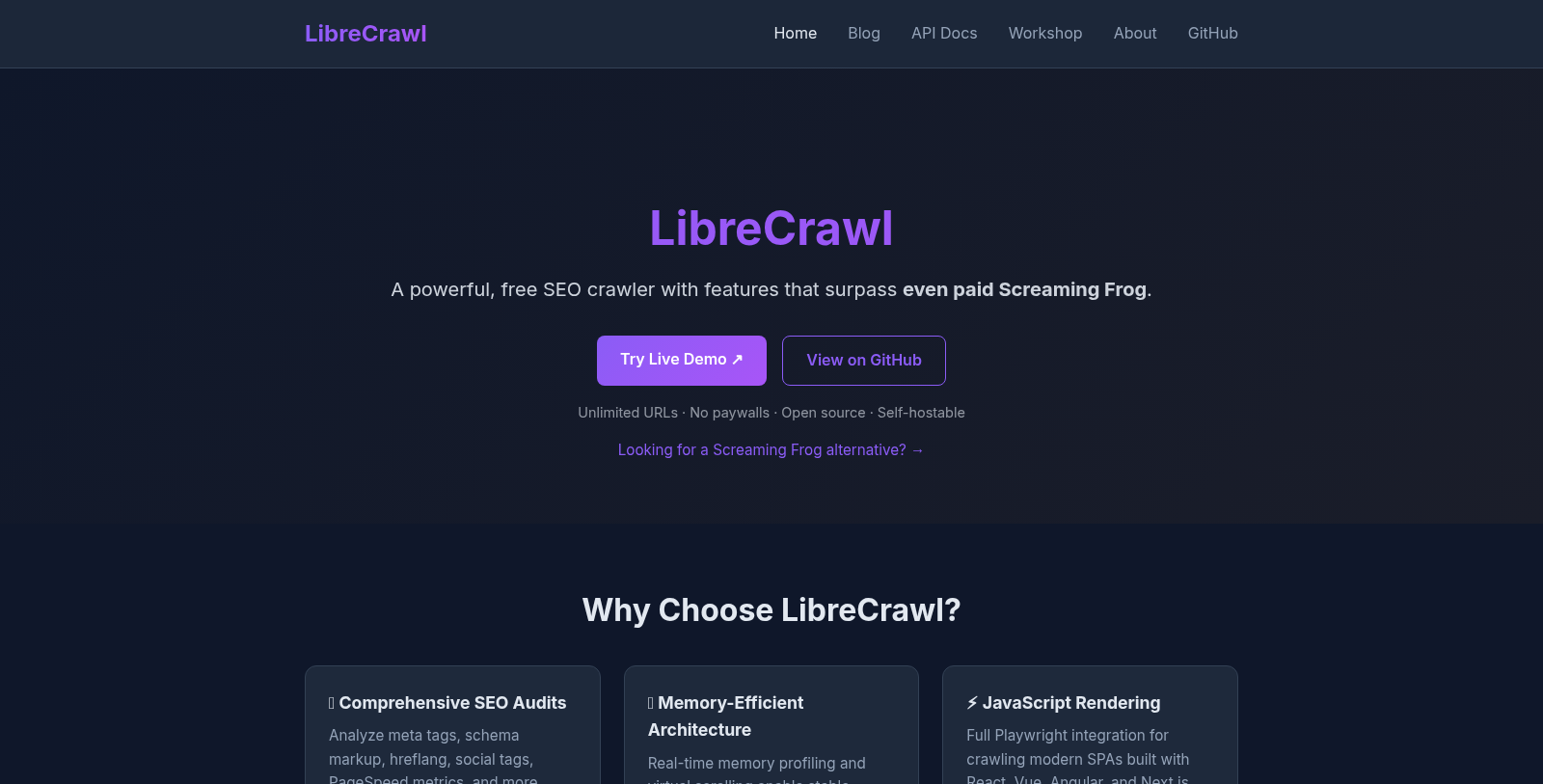
LibreCrawl is a powerful, free SEO crawler with features that surpass even paid tools like Screaming Frog. Designed with the mission to democratize technical SEO, LibreCrawl removes artificial limitations like 500 URL caps and hefty licensing fees. It allows for unlimited URL crawling, JavaScript rendering, and comprehensive technical audits, providing unparalleled capabilities without the financial strain.
Why Choose LibreCrawl?
With a focus on accessibility and performance, LibreCrawl delivers comprehensive SEO audits that analyze various meta tags, schema markup, hreflang attributes, social tags, PageSpeed metrics, and beyond. Its memory-efficient architecture ensures the smooth handling of crawls, even for sites exceeding 1 million URLs, thanks to real-time memory profiling and virtual scrolling technology.
Key Features Highlights:
- Unlimited Crawling: Analyze any number of URLs without restrictions.
- JavaScript Rendering: Full Playwright integration allows accurate crawling of modern SPAs built with frameworks such as React, Vue, Angular, and next.js.
- Unlimited Exports: Export your data in CSV, JSON, or XML formats. Create multiple exports with no restrictions, choosing custom fields as needed.
- Open Source & Self-Hostable: Fully transparent code available under the MIT license on GitHub, giving users complete control over their data while ensuring privacy.
- Advanced Features: Numerous modern features such as issue filtering, custom CSS injection, multi-session support, and detailed link tracking help users tailor their crawling experience.
Benefits for Various User Types:
For SEO Agencies, LibreCrawl frees teams from worrying about licensing costs, enabling the execution of unlimited client audits efficiently. Agencies can scale from two to twenty team members without increasing their software budget.
Enterprise teams find value in handling large, complex websites without incurring significant costs or limitations. The tool's self-hosting capabilities ensure compliance with strict security and data privacy standards, catering to enterprise needs.
Freelancers benefit from zero annual costs, gaining access to professional-grade analysis tools that empower them to compete effectively in their field. E-commerce businesses can efficiently audit vast product catalogs, ensuring SEO integrity across thousands of pages.
Content publishers and media sites enhance their output by auditing internal linking strategies, validating schema markup, and improving content discoverability. Moreover, SaaS and tech companies can ensure their marketing sites and documentation are optimized for search engines through accurate assessments provided by LibreCrawl.
Technical Features: A Deeper Dive
LibreCrawl excels in technical SEO analysis. It identifies issues such as broken links, duplicate content, redirects, and missing metadata while validating structured data implementation. The tool's advanced features allow for thorough analysis of internal linking structures and page speed metrics, ensuring robust optimization of ever-evolving websites.
Community Engagement:
LibreCrawl thrives on community involvement. Its successful development stems from user feedback and contributions, creating a collaborative ecosystem. By engaging with the community, users can influence future features and improvements, reinforcing its open-source ethos.
Getting Started:
The installation of LibreCrawl is straightforward, requiring basic command-line knowledge. Users can opt to test features without installation by accessing a demo. For those interested in customization, LibreCrawl's MIT license allows extensive modifications to suit diverse needs.
In conclusion, LibreCrawl stands as a potent alternative to typical crawling tools, fostering accessibility to advanced SEO capabilities. With its array of robust features and zero-cost commitment, it effectively meets modern industry demands without compromise.
Pros & Cons
Pros
- Unlimited URL crawling capabilities with no artificial limits or paywalls.
- Offers advanced features like JavaScript rendering and real-time memory profiling.
- Completely open-source with full control over deployment and data privacy.
Cons
- Lacks dedicated commercial support and specialized features like log file analysis.
Frequently Asked Questions
LibreCrawl is available at no cost.
According to our latest information, this tool does not seem to have a lifetime deal at the moment, unfortunately.
LibreCrawl offers several advanced features, including real-time memory profiling, virtual scrolling for stable crawls of over 1 million URLs, and built-in JavaScript rendering using Playwright. It also includes issue filtering, multi-session support for simultaneous projects, custom CSS injection, and unlimited exports in CSV, JSON, or XML formats. These features are designed to provide a comprehensive technical SEO audit experience without the limitations often found in other tools.
LibreCrawl is designed with a strong focus on privacy. It does not track users or collect analytics on crawling behavior. Additionally, as an open-source tool, users have full access to the codebase, allowing them to confirm that no data is sent to third-party servers. For maximum control, users are encouraged to self-host LibreCrawl on their own infrastructure, ensuring that all crawl data remains private and under their control.
Yes, LibreCrawl is self-hostable, allowing users to run it on their own servers. The installation process is straightforward for those with basic server administration skills. Users need to have Python 3.8 or later installed, and the setup includes cloning the repository, installing necessary dependencies, and running the Playwright installer to fetch browser binaries. Detailed setup instructions are available in the GitHub repository.
LibreCrawl allows users to crawl an unlimited number of URLs without imposing restrictions or paywalls. Unlike other tools that cap crawl limits by subscription tier, LibreCrawl's only limitation is the user's hardware capacity. The tool is built with advanced memory management techniques, allowing it to handle large sites efficiently, even those with millions of pages.
LibreCrawl supports multiple export formats, including CSV, JSON, and XML, for reporting or integration with other tools. Furthermore, it offers a customizable export option that lets users select specific fields to include in their reports. The unlimited export option allows users to create as many reports as needed without any restrictions on size or frequency.
Yes, LibreCrawl has an active community that provides support through GitHub. Users can report bugs, request features, and discuss issues in the GitHub Issues and Discussions sections. Many common queries are also addressed in the documentation. The community is known for quick responses, often within 24-48 hours, helping users resolve issues efficiently.
For small to medium-sized sites (under 100,000 URLs), a machine with 8GB of RAM and a modern processor is sufficient. However, for larger crawls, especially those involving millions of URLs, it is recommended to have 16-32GB of RAM. LibreCrawl includes a memory profiling feature that helps users monitor resource usage and optimize settings based on their specific hardware capabilities.
Absolutely! LibreCrawl is open source and licensed under the MIT license, allowing users to fork the repository, modify the source code, and add specific features or customizations as needed. Users can change issue detection rules, implement new export formats, or even create a customized user interface. While modifications can be kept private, contributions back to the main project are encouraged to benefit the community.