











LightRAG
Enhances language models with graph-based dual-level retrieval for accurate and context-aware responses.
Github.io
Is this your tool?
Follow for updates & deals
Get alerts for LightRAG discounts, feature releases & pricing changes
Similar Tools
LOVO
Generate realistic voiceovers from text with a versatile AI text-to-speech tool.
NuExtract
Extract structured data from various document formats using advanced language models.

poolside
Provides tailored AI models for software engineering to enhance development and ensure data security.

AKOOL
Generative AI platform for creating personalized visuals and interactive marketing content.

Emergent
Build web and mobile applications using AI with natural language prompts and minimal coding required.

LightRAG Media Gallery

LightRAG (review) video
Screenshot of LightRAG
What is LightRAG?
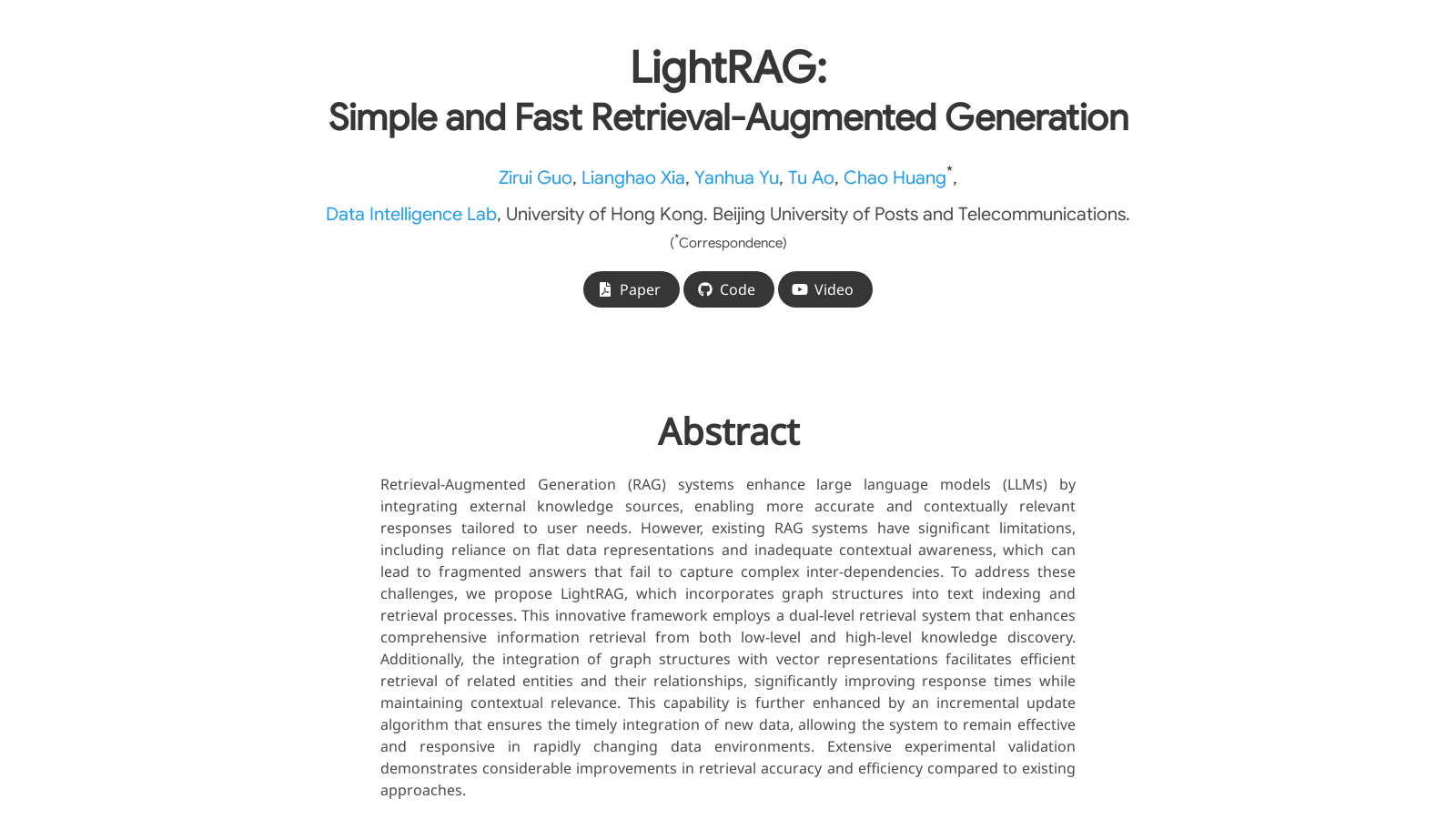
Retrieval-Augmented Generation (RAG) systems significantly enhance the capabilities of large language models (LLMs) by incorporating external knowledge sources, providing users with more accurate and context-aware responses tailored to their specific needs. Despite these advancements, traditional RAG systems exhibit notable limitations; they often depend on flat data representations and have inadequate contextual awareness, which can lead to fragmented answers that overlook complex relationships. To tackle these issues, we present LightRAG, an innovative framework that integrates graph structures into the text indexing and retrieval processes.
LightRAG employs a dual-level retrieval system that allows for comprehensive information retrieval from both low-level and high-level knowledge sources. By merging graph structures with vector representations, the system improves the efficiency of retrieving related entities and their interconnections, dramatically enhancing response times while preserving contextual relevance. This functionality is bolstered by an incremental update algorithm that facilitates the timely integration of new data, enabling the system to adapt and remain effective in rapidly changing information environments. Extensive experimental validation demonstrates that LightRAG achieves substantial improvements in retrieval accuracy and efficiency compared to existing methods.
Key Features of LightRAG
LightRAG introduces several distinctive features that set it apart from traditional RAG systems. Foremost, it incorporates graph structures to enhance contextual understanding, effectively addressing common limitations of conventional RAG approaches. The dual-level retrieval framework enables users to extract information at both the abstract and specific levels, ensuring comprehensive answers to complex queries.
Graph Structure Integration
By leveraging graph structures, LightRAG not only improves the accuracy and relevance of retrieved information but also enhances response times. This is achieved through more efficient indexing and retrieval methodologies, allowing the system to deliver the right information when needed.
Incremental Updates
The incremental update algorithm of LightRAG allows for the seamless integration of new documents and data points without requiring a complete rebuild of the entire knowledge graph. This ensures that users always receive the most timely and relevant information, making the system particularly useful in rapidly evolving data landscapes.
Comprehensive Knowledge Graph Management
LightRAG offers robust support for the creation, editing, and management of knowledge graphs. Users can incorporate custom knowledge graphs to enhance the model's understanding with domain-specific insights, thus making the tool highly adaptable across various fields and applications.
Technical Advances in LightRAG
LightRAG's architecture incorporates advanced techniques that refine its retrieval capabilities. For instance, the system enhances entity and relationship extraction by segmenting documents into manageable pieces. This segmentation allows for swift access to relevant details without needing to analyze entire documents, and LLMs play a crucial role in identifying and extracting various entities and their interrelationships. This comprehensive extraction process serves as the foundation for constructing knowledge graphs that highlight connections across a complete set of documents.
Dual-Level Retrieval Paradigm
LightRAG's dual-level retrieval paradigm allows it to address both specific queries—focused on detail-oriented information—and abstract queries that encompass broader topics and themes. Implementing distinct retrieval strategies for each level ensures that user queries receive relevant and accurate responses, enhancing the overall efficacy of the system.
Use Cases
LightRAG is ideal for various applications, ranging from academic research to industrial settings where fast and precise information retrieval is essential. Its multimodal data handling capabilities enable the system to efficiently process diverse formats, including PDFs, images, and tables. Consequently, researchers, data scientists, and technology practitioners can leverage LightRAG to derive insights promptly and effectively.
Conclusion
In summary, LightRAG represents a significant advancement in the landscape of retrieval-augmented generation, effectively bridging the gap between efficiency and accuracy in information retrieval. By integrating sophisticated graph structures and an adaptable retrieval methodology, LightRAG substantially enhances the performance of large language models, positioning itself as an invaluable resource for both research and practical applications.
Pros & Cons
Pros
- Integrates graph structures to enhance retrieval accuracy and contextual relevance.
- Offers a dual-level retrieval system for effective knowledge discovery across different data types.
- Supports multimodal document processing, including text, images, and tables.
Cons
- Requires explicit initialization for successful operation, which may confuse new users.
Frequently Asked Questions
LightRAG is open source and free to use.
According to our latest information, this tool does not seem to have a lifetime deal at the moment, unfortunately.
LightRAG offers several innovative features, including a dual-level retrieval system that enhances information retrieval from both low-level and high-level knowledge. It employs graph structures for efficient indexing and retrieval, which improves contextual awareness and response accuracy. The system also supports incremental updates, enabling the timely integration of new data and ensuring relevance in dynamic environments. Additionally, features like multimodal data handling, citation functionality, and a user-friendly Graph Visualization interface make it a robust tool for retrieval-augmented generation.
LightRAG provides support for seamless integration of custom knowledge graphs, allowing users to enhance the system with domain-specific expertise. Users can insert and manage custom graph entities and their relationships through the LightRAG Server interface or via the API. To get started, refer to the integration section in the LightRAG documentation for detailed steps on how to create, edit, and delete entities within your custom knowledge graph.
LightRAG now supports various document formats for multimodal processing, including PDFs, DOC/DOCX, PPT/PPTX, images, and tables. This functionality is facilitated through the integration of RAG-Anything, which allows for seamless parsing and retrieval of content across these diverse formats. Users can extract structured content and utilize it for generating contextual responses using LightRAG's retrieval-augmented generation capabilities.
If you face errors such as AttributeError or KeyError during initialization, it's crucial to ensure that you've properly initialized the storage backends and the pipeline status. Specifically, after creating a LightRAG instance, you must call await rag.initialize_storages() and await initialize_pipeline_status(). These two calls are essential to prevent common errors related to uninitialized components.
Yes, LightRAG allows users to inject different LLM and embedding models, including those from OpenAI, Hugging Face, and Ollama. During the initialization phase, you'll specify these models using their respective functions. This flexibility enables users to tailor the system according to their specific needs and optimize performance based on available resources or desired output styles.
To deploy LightRAG, you can install the server via Docker or from source. For Docker, clone the repository, copy the example environment configuration, modify it for your LLM and embedding settings, and run 'docker compose up'. Alternatively, for a source installation, ensure you have a Python virtual environment, then run 'pip install -e.[api] after cloning the repository. Refer to the LightRAG installation guide for detailed instructions.
LightRAG employs an incremental update algorithm that enables it to incorporate new data without requiring a complete reprocessing of the existing knowledge base. This approach maintains the integrity of the graph structure by merging new entities and relationships with those already stored. As a result, LightRAG can quickly adapt to changes and enhance its performance while ensuring users have access to the most current information.
When using LightRAG, it's essential to separate the inquiry from output processing. Use the user_prompt parameter to guide the LLM on how to process results after the query phase. For optimal results, formulate queries either as specific questions targeting particular entities or as broader abstract inquiries aiming for comprehensive themes. This ensures effective retrieval using LightRAG's dual-level retrieval capabilities, enabling you to leverage both specific and conceptual knowledge effectively.