











MetaVoice

AI-powered voice system enabling natural and emotionally aware conversations without traditional turn-taking.
Metavoice.io
Is this your tool?
Follow for updates & deals
Get alerts for MetaVoice discounts, feature releases & pricing changes
Similar Tools

vui
Conversational speech models running on-device.

Fluently
AI-driven English tutor for personalized speaking practice and instant feedback.

David AI
Provides curated audio datasets for training speech and conversational AI models.

Deepgram
Real-time voice AI agents for speech-to-text and text-to-speech integration in applications

MyAudioJournal
Capture your thoughts through voice with an audio journaling app that aids personal growth.

MetaVoice Media Gallery
What is MetaVoice?
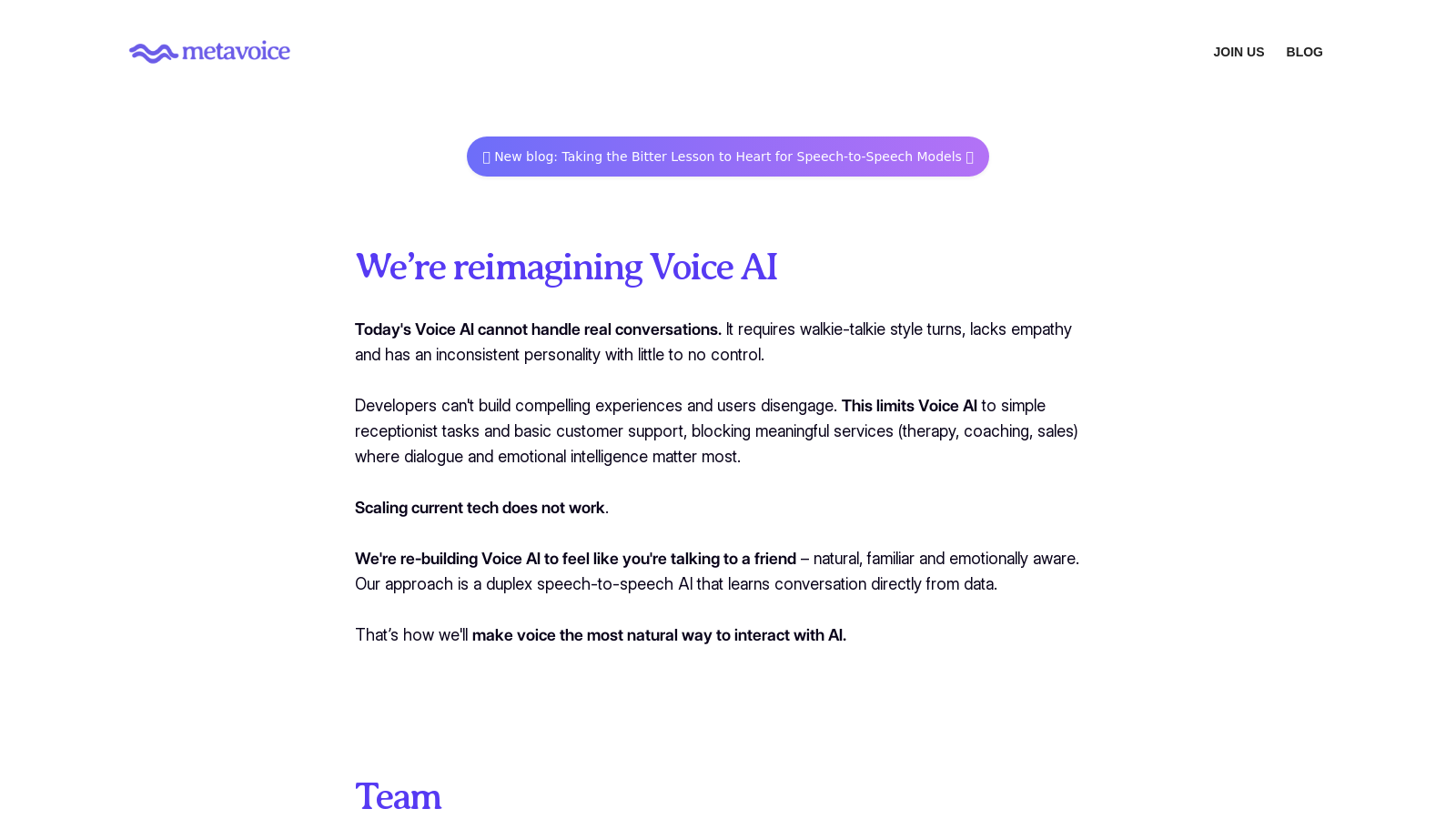
MetaVoice is redefining the landscape of voice AI, striving to create systems that facilitate genuine, emotionally aware conversations. The current state of voice AI is limited, often requiring users to engage in turn-based interactions similar to walkie-talkies, which severely restricts the fluidity and emotional depth of dialogue. MetaVoice's innovative approach is aimed at tearing down these limitations, allowing for seamless and natural conversations that feel as intuitive as speaking with a friend.
Traditional voice AI systems often lag in their ability to handle nuanced conversations, limiting their application to simple tasks like customer service and basic inquiries. This is primarily because these systems rely on rigid communication structures that fail to accommodate the dynamic nature of real conversations. MetaVoice, however, leverages a sophisticated duplex speech-to-speech model that learns from authentic conversational data, enabling it to manage simultaneous speech and unexpected interruptions much like humans do. This capability is essential for more specialized fields, such as therapy, coaching, and sales, where emotional complexity in dialogue is crucial.
An Innovative Approach to Voice Communication
The core of MetaVoice's technology lies in its commitment to a duplex model that fosters deeper engagement. For voice AI to resonate with users, it must not only comprehend the spoken words but also respond in a manner that mirrors human conversational patterns—including overlapping dialogue and non-verbal cues. The objective is to develop voice AI that embodies the naturalness and warmth of friendly exchanges.
Overcoming Current Limitations
Current voice AI technologies excel in straightforward tasks, yet fall short in facilitating complex, engaging conversations. Conventional models operate on a turn-taking basis, which can overlook the emotional nuances necessary for meaningful dialogues. MetaVoice’s duplex architecture enables real-time interactions, enhancing the ability to react responsively as conversations ebb and flow.
The Science Behind Speech Training
To foster these naturally conversational capabilities, training the system on diverse and rich datasets that capture everyday speech patterns is vital. Unfortunately, existing datasets often fail to reflect the subtleties of human interaction, which can result in suboptimal training outcomes. MetaVoice addresses this challenge by utilizing advanced speech separation models that distinguish between speakers, providing the essential dual-channel audio required for effectively training its duplex architecture.
Future of Voice Interactions
As the field of voice AI evolves, MetaVoice remains dedicated to enhancing its model capabilities and enriching user experiences. By developing a system that comprehends not just the words spoken, but the emotions and contexts surrounding those words, the potential applications for this technology extend well beyond conventional customer service interactions. Potential innovations are aimed at making voice interactions indistinguishable from human conversations, even after prolonged engagements.
Cultural Perspectives and Development
The team behind MetaVoice is motivated by a vision of technology that serves humanity. Their collaborative and in-person culture fosters an innovative environment where rapid progress in product development is achieved. This collective effort and real-time idea exchange play a pivotal role in crafting AI products that users will genuinely appreciate and engage with.
Recent advancements have highlighted the critical need to overcome the core limitations faced by existing voice AI technologies—particularly in the areas of speech recognition and response generation. For instance, many current systems rely on a turn-based model defined by text-based Q&A setups which inherently do not translate well to fluid spoken exchanges. By switching to a duplex model, MetaVoice aligns more closely with the naturally overlapping speech found in human dialogues, providing a more authentic conversational experience.
In their latest blog posts, the team discusses the challenges and breakthroughs in training the system to handle the intricacies of real-world speech, such as overlaps and backchannels. They emphasize the necessity of developing robust data acquisition methods to enable training on cleanly separated audio tracks, thus paving the way for significant advancements in conversation quality and depth.
Pros & Cons
Pros
- Utilizes duplex models for more natural, overlapping conversations in voice AI.
- Deeply understands context to adjust tone and flow, enhancing user engagement.
- Excels in recognizing and articulating complex phrases, improving communication clarity.
Cons
- Requires clean, separated audio datasets for effective training, which are hard to obtain.
Frequently Asked Questions
MetaVoice is free to start, with paid plans from 0 to 0 USD per Translation not found for 'time_period_unknown'.
According to our latest information, this tool does not seem to have a lifetime deal at the moment, unfortunately.
MetaVoice incorporates duplex speech-to-speech technology, allowing for simultaneous speaking and listening, thereby mimicking natural human conversations. This contrasts with traditional systems that rely on turn-taking models, resulting in awkward interruptions. MetaVoice focuses on emotional awareness and contextual tone adjustments, making interactions feel more like conversations with a friend rather than with a robotic entity.
MetaVoice utilizes advanced speech models that can interpret the context of conversations. This means that the AI is capable of recognizing and responding to nuances such as tone and emotional cues, allowing it to adjust its responses accordingly. For instance, it can alter its tone to match a user's mood, creating a more engaging and human-like dialogue experience.
MetaVoice is designed for various use cases where emotional intelligence is crucial, such as therapy, coaching, sales, and customer support. By providing a voice that engages users naturally and effectively, organizations can enhance customer satisfaction, improve interaction quality, and automate processes that typically require human empathy and understanding.
The duplex model that MetaVoice employs is adept at handling conversational characteristics, such as overlaps and backchannels, which are often overlooked by traditional Voice AI systems. By leveraging a rich dataset that includes these elements, MetaVoice can maintain a flowing dialogue that reflects genuine human interactions, thereby reducing instances of awkward pauses and interruptions commonly found in current solutions.
MetaVoice trains its models on a diverse set of conversational datasets that capture the complexities of human dialogue, including interruptions, emotions, and nuanced expressions. Unlike traditional methods that filter out overlapping speech, MetaVoice employs duplex learning, enabling models to learn from raw, unfiltered conversational data, thereby enhancing their ability to interact naturally.
Yes, MetaVoice is engineered explicitly for long-form conversations. The duplex architecture enables it to sustain dialogues that mimic human interactions effectively, making it ideal for applications that require prolonged engagement, such as virtual therapy sessions or in-depth customer service calls.
One of the primary challenges is acquiring clean, separated audio tracks necessary for training duplex models. Most existing conversational datasets are comprised of mixed recordings, making it challenging to extract usable training data. MetaVoice is actively developing sophisticated speech separation models to address this bottleneck, ensuring high-quality training inputs that enhance performance in real-world applications.
While specific technical requirements are outlined on the official MetaVoice website, businesses typically require a reliable infrastructure for cloud services and APIs to leverage the advanced capabilities of MetaVoice fully. Companies interested in incorporating this technology should also consider their user interaction scenarios to maximize the benefits of a voice AI that understands and adapts to conversational cues.