











MuseNet

Generates diverse music compositions by blending styles and instruments using deep learning.
Openai.com
Is this your tool?
Follow for updates & deals
Get alerts for MuseNet discounts, feature releases & pricing changes
Similar Tools

MiniMax
Provides AI solutions for search and chat across various media formats.

Subtxt
A data-driven tool that helps writers enhance narrative clarity and consistency in their stories.

DeckSpeed
Create personalized slide presentations through an interactive conversation process.

Ghost
Create and edit presentations effortlessly with an AI-powered slide editor designed for fast, beautiful results.

FableAI
Create unique, interactive text adventures where your choices shape the story.

MuseNet Media Gallery

MuseNet (review) video
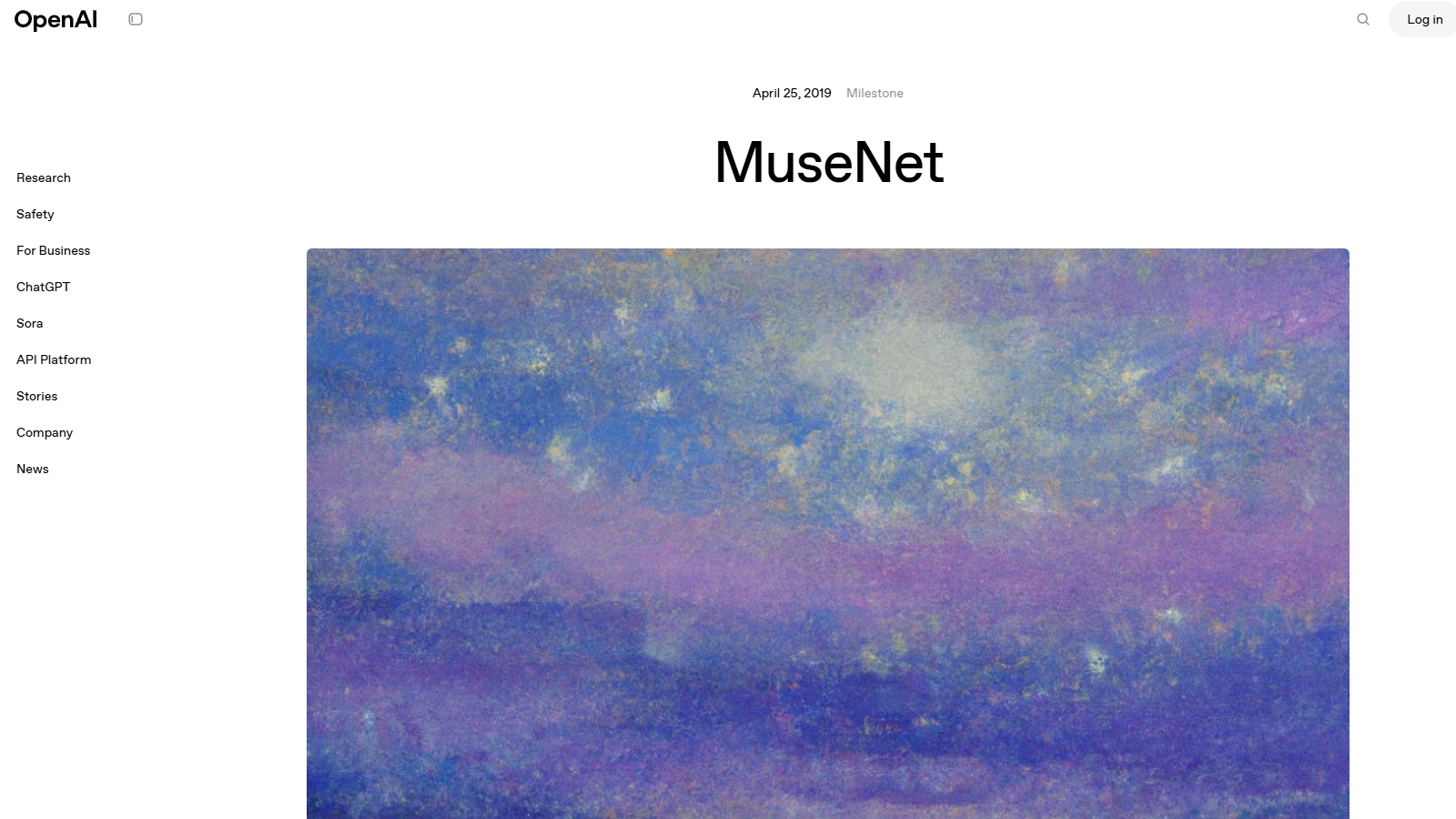
Screenshot of MuseNet
What is MuseNet?
MuseNet is a versatile deep neural network developed by OpenAI designed to generate musical compositions lasting up to four minutes. With its advanced capabilities, it can create music using a diverse range of ten different instruments and blend musical styles that encompass everything from classical works to popular music genres, including country, Mozart, and even the Beatles. The technology behind MuseNet is exceptional because it does not rely on explicit programming or predefined rules about music; rather, it learns by identifying patterns of harmony, rhythm, and style through extensive training conducted on hundreds of thousands of MIDI files.
The underlying technology of MuseNet employs the same general-purpose unsupervised learning methods as OpenAI's GPT-2, a transformer model adept at processing both audio and text sequences. This allows MuseNet to grasp and create complex musical structures, resulting in outputs that integrate diverse musical elements in a coherent and creative manner.
A striking feature of MuseNet is its ability to mix distinct musical styles into innovative compositions. For instance, a user could provide an initial sequence of six notes from one of Chopin's works and request MuseNet to generate a continuation in a pop style with instruments such as piano, drums, bass, and guitar. The output exemplifies a convincing fusion of classical and contemporary music elements, underscoring MuseNet's artistic potential.
Modes of Interaction
MuseNet presents various interaction modes tailored to different users, whether they are musicians or non-musicians aspiring to create musical compositions:
- Simple Mode: This user-friendly mode allows individuals to listen to randomly generated samples without needing to customize inputs. Users can select a composer or style and immediately begin generating music, providing an excellent opportunity to explore the vast variety of musical styles that MuseNet can produce.
- Advanced Mode: For those seeking more control, this mode enables users to interact directly with the model. Although generation takes longer, it allows for greater creative freedom, enabling users to craft entirely new pieces based on their specific inputs and adjustments.
Understanding MuseNet's Limitations
While MuseNet is a powerful tool for music generation, it is essential for users to recognize its limitations. The instruments specified by the user serve primarily as suggestions rather than strict requirements. MuseNet generates compositions by calculating the probabilities of each note and instrument, meaning there is always a chance that it may select unexpected elements. For unconventional combinations of styles and instruments— such as marrying classical composers with modern percussion—MuseNet may falter in delivering the desired results. To achieve optimal output, users are encouraged to select instrument pairings that align more naturally with the chosen musical genre.
Training and Technology
MuseNet's development involved substantial training on a variety of musical datasets, with significant contributions from Classical Archives and BitMidi, along with other online collections featuring genres ranging from jazz to pop, and even African, Indian, and Arabic music styles. The training methodology utilized sophisticated tokenization techniques that amalgamate pitch, volume, and instrument data into singular tokens. This approach allows MuseNet to effectively learn the intricate subtleties necessary for skillful musical composition.
Future of Music Generation
MuseNet is poised to have a transformative effect on the music generation landscape. As it attracts users from both amateur and professional spheres, it is expected to foster new musical creations across diverse genres, potentially leading to the emergence of entirely new musical styles. Users who compose pieces they wish to share are encouraged to upload them to platforms such as Instaudio, promoting community engagement and collaborative contributions to MuseNet's outputs. This collaborative spirit further enriches the music creation ecosystem.
In summary, MuseNet represents a sophisticated approach to music generation that appeals to a wide audience. It provides innovative tools for musicians, hobbyists, and anyone interested in exploring the remarkable potential of AI-driven creativity in music.
Pros & Cons
Pros
- Generates 4-minute compositions with 10 instruments across various musical styles.
- Learns from patterns of harmony and rhythm instead of being pre-programmed with music theory.
- Allows for creative blending of musical styles and prompts, enabling novel compositions.
Cons
- Instrument choices are merely strong suggestions, not guaranteed outputs.
Frequently Asked Questions
We have no pricing information available now, so please check the MuseNet's website.
According to our latest information, this tool does not seem to have a lifetime deal at the moment, unfortunately.
With MuseNet, you can create 4-minute musical compositions featuring up to 10 different instruments. The tool is capable of blending various musical styles, including classical composers like Mozart and modern styles like pop or country, allowing you to explore unique genre combinations.
In MuseNet, the instruments you select act as strong suggestions rather than strict requirements. The model generates music by calculating probabilities across all possible notes and instruments, which means there's always a chance it might select an instrument different from the one you input. For the best results, choose instruments that are typical for the style or composer you are prompting.
In simple mode, MuseNet plays random, pre-generated samples, providing an easy way to explore various musical styles. Advanced mode enables more interaction, allowing you to create entirely new pieces by providing initial notes and selecting composers or styles. This mode takes longer to generate completions but offers more creative control over the compositions.
MuseNet has some limitations, such as difficulty in producing natural-sounding compositions when combining unusual style and instrument pairings. For instance, pairing classical composers like Chopin with contemporary instruments like drums and bass may not yield optimal results. Additionally, the generated pieces may not depend strictly on the chosen instruments, leading to unexpected outcomes.
To get started with MuseNet, visit the official MuseNet demo on the OpenAI website. Begin in simple mode to familiarize yourself with sound generation. Experiment with selecting different composers, styles, and initial notes to see how the model responds. Once comfortable, switch to advanced mode for more control and creative freedom over your compositions.
MuseNet is primarily designed as a standalone tool; however, if you create musical pieces you enjoy, you can share these compositions on platforms like Instaudio. Refer to the official OpenAI documentation for details on any specific integration capabilities or updates regarding MuseNet's availability in various environments.
MuseNet is trained on a vast dataset collected from various sources, including classical archives and online MIDI collections that feature genres such as jazz, pop, and traditional music from around the world. This diverse range allows the model to learn harmonies, rhythms, and styles, enabling it to generate varied musical compositions.
To enhance your compositions with MuseNet, select instruments characteristic of the style you aim to replicate and consider using well-known pieces as prompts, as the model can effectively blend familiar themes. Experiment with different combinations of styles and instruments, keeping the unique character of the chosen composer in mind, to enhance creativity in the output.