











TensorZero

Streamlines integration and optimization of large language models for industrial applications.
Tensorzero.com
Is this your tool?
Follow for updates & deals
Get alerts for TensorZero discounts, feature releases & pricing changes
Similar Tools

Wayve
Automated driving solution utilizing AI for safe and adaptable navigation without reliance on HD maps.

Sliq
Automated data cleaning for better data analysis.

NetMind
Integrate and optimize AI models using a range of APIs and scalable GPU clusters.

Firebase
Development platform for mobile and web apps with real-time databases, hosting, and analytics services.

Gretel
Generate synthetic datasets for AI applications while ensuring data privacy and compliance.

TensorZero Media Gallery

TensorZero (review) video
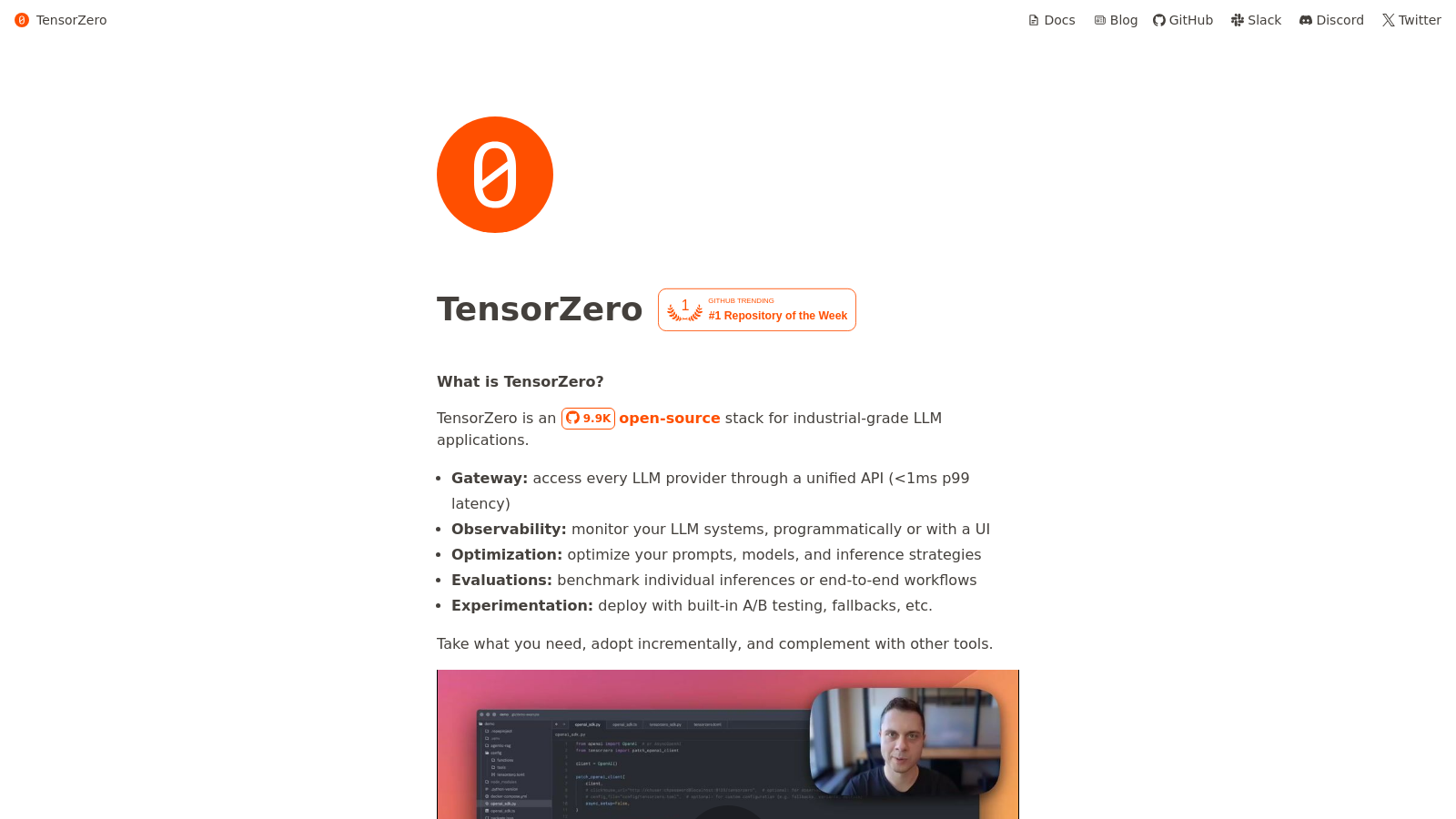
Screenshot of TensorZero
What is TensorZero?
TensorZero is an open-source stack designed explicitly for industrial-grade LLM (Large Language Model) applications, streamlining the integration and optimization of machine learning models. It is engineered to assist a wide array of users—from frontier AI startups to Fortune 50 companies—by providing robust features that cater to the complexities of LLM operations.
Unified API Gateway: A highlight of TensorZero is its unified API gateway, which grants access to all major LLM providers with notably low latency, achieving under 1ms at the p99 percentile. This allows users to integrate seamlessly with providers such as OpenAI, Anthropic, and others, optimizing operational efficiency across diverse projects.
TensorZero Autopilot: A recent addition, TensorZero Autopilot is an automated AI engineer that aids teams in optimizing LLM workflows. It analyzes observability data, recommends viable models, and enhances implementation strategies through fine-tuning and reinforcement learning. This feature empowers teams to automate much of the engineering process while retaining control and visibility over their systems.
Observability and Monitoring: TensorZero boasts strong observability capabilities that allow users to monitor LLM systems either programmatically or via an intuitive user interface. This includes tracking individual inferences and collecting a variety of performance metrics that simplify ongoing evaluation and optimization tasks.
Optimization and Experimentation: The platform further facilitates the optimization of prompts, models, and inference strategies. Users can engage in built-in A/B testing, experimenting with varied models and prompts in real-time to make data-driven improvements to their applications.
Evaluations and Benchmarking: TensorZero offers comprehensive evaluation features, enabling users to benchmark individual inferences and end-to-end workflows. This benchmarking can be accomplished against established heuristics or LLM judgments, fostering informed decision-making based on comparative analyses.
Quick Start Guide: TensorZero simplifies the initiation process, equipping developers to set up production-ready LLM applications quickly—often within minutes. This gradual adoption framework allows teams to implement only the necessary features at first, with opportunities to incrementally integrate additional functionalities as projects evolve.
Enterprise Support: While TensorZero is free and open-source, it also provides dedicated enterprise-level support channels, reflecting a strong commitment to assisting teams throughout their integration efforts.
Community and Contribution: As an open-source tool, TensorZero encourages contributions from the developer community and actively fosters participation. The goal is to cultivate an ecosystem around LLM applications that not only addresses current needs but also propels emerging innovations in AI technology.
Vision and Roadmap: The overarching aim of TensorZero is to enable LLM applications to learn and optimize from real-world experiences effectively. The future roadmap outlines plans to introduce advanced optimization techniques and broader integrations, ensuring TensorZero remains at the cutting edge of LLM engineering.
Conclusion: In summary, TensorZero is not just a tool but a comprehensive ecosystem designed to manage LLM applications with a strong emphasis on performance, observability, and user autonomy. This innovative solution mitigates the complexities associated with LLM integration, enhancing the operational capabilities of developers and engineers dedicated to deploying advanced AI-driven applications.
Pros & Cons
Pros
- Offers a unified API for accessing multiple LLM providers, enhancing flexibility.
- Includes built-in observability tools for monitoring LLM performance and metrics.
- Supports seamless experimentation with A/B testing and automatic fallbacks.
Frequently Asked Questions
TensorZero is available at no cost.
According to our latest information, this tool does not seem to have a lifetime deal at the moment, unfortunately.
TensorZero provides a comprehensive optimization framework that includes prompt optimization, model fine-tuning, and inference-time optimizations. Users can gather metrics and human feedback to optimize their models and strategies effectively. With features such as structured inferences and optimization recipes, TensorZero enables developers to refine and enhance the performance of their LLM applications using real-world data.
TensorZero integrates with a wide range of LLM providers, including OpenAI, Anthropic, AWS Bedrock, and Google AI Studio, among others. This unified API enables developers to switch between different providers seamlessly and utilize multiple models as needed. Furthermore, users can also integrate TensorZero with other tools and systems for enhanced functionality.
While TensorZero offers powerful features for LLM application development, it is essential to keep in mind that it relies on the performance and capabilities of the underlying LLM providers. Users may encounter limitations based on the specific models used or the configurations they implement. Additionally, TensorZero may require proper setup for observability and fine-tuning to leverage all its features effectively.
Yes, TensorZero is designed to be production-ready, as evidenced by various case studies, such as the automation of code changelogs at a large bank. Users can quickly set up LLM applications with observability and fine-tuning capabilities, ensuring robust performance and stability in production settings while maintaining flexibility and adaptability.
TensorZero can be used with its Python SDK as well as any OpenAI SDK (including Python, Node, Go, etc.) or via its HTTP API. This broad compatibility ensures that developers can easily integrate TensorZero into their existing workflows and utilize its features regardless of their preferred programming language.
Users can reach out for support or to provide feedback via multiple channels, including Slack, Discord, and GitHub. TensorZero encourages community engagement, allowing developers to ask questions, share suggestions, and report issues as they explore and use the tool.
TensorZero is versatile and can support a variety of applications, such as chatbots, email assistants, weather systems, and structured data extraction pipelines. The platform's modular design allows developers to leverage its features by focusing on specific use cases and customizing their implementation according to their objectives.
TensorZero is an open-source project, and the team welcomes contributions from the community. Developers interested in collaborating can check the project's GitHub repository, contribute code, provide feedback, and propose new features. Additionally, TensorZero is actively hiring and offering opportunities for those looking to join its development team.