











Archimyst

Create and test complex system architectures using AI-driven simulations and visual design tools.
Archimyst.com
Is this your tool?
Follow for updates & deals
Get alerts for Archimyst discounts, feature releases & pricing changes
Similar Tools

Kiro
Streamlines coding from specifications to structured implementation with AI-driven support.

AgentQL
Automate web data extraction and interactions using a natural language query language.

Tavily
Search engine APIs that improve AI models by providing real-time, relevant web data integration.

Gemini CLI
Integrates Gemini AI into the terminal for efficient code interaction and workflow automation.

Vellum
Facilitates AI development, testing, and deployment with a focus on collaboration and iteration.

Archimyst Media Gallery
What is Archimyst?
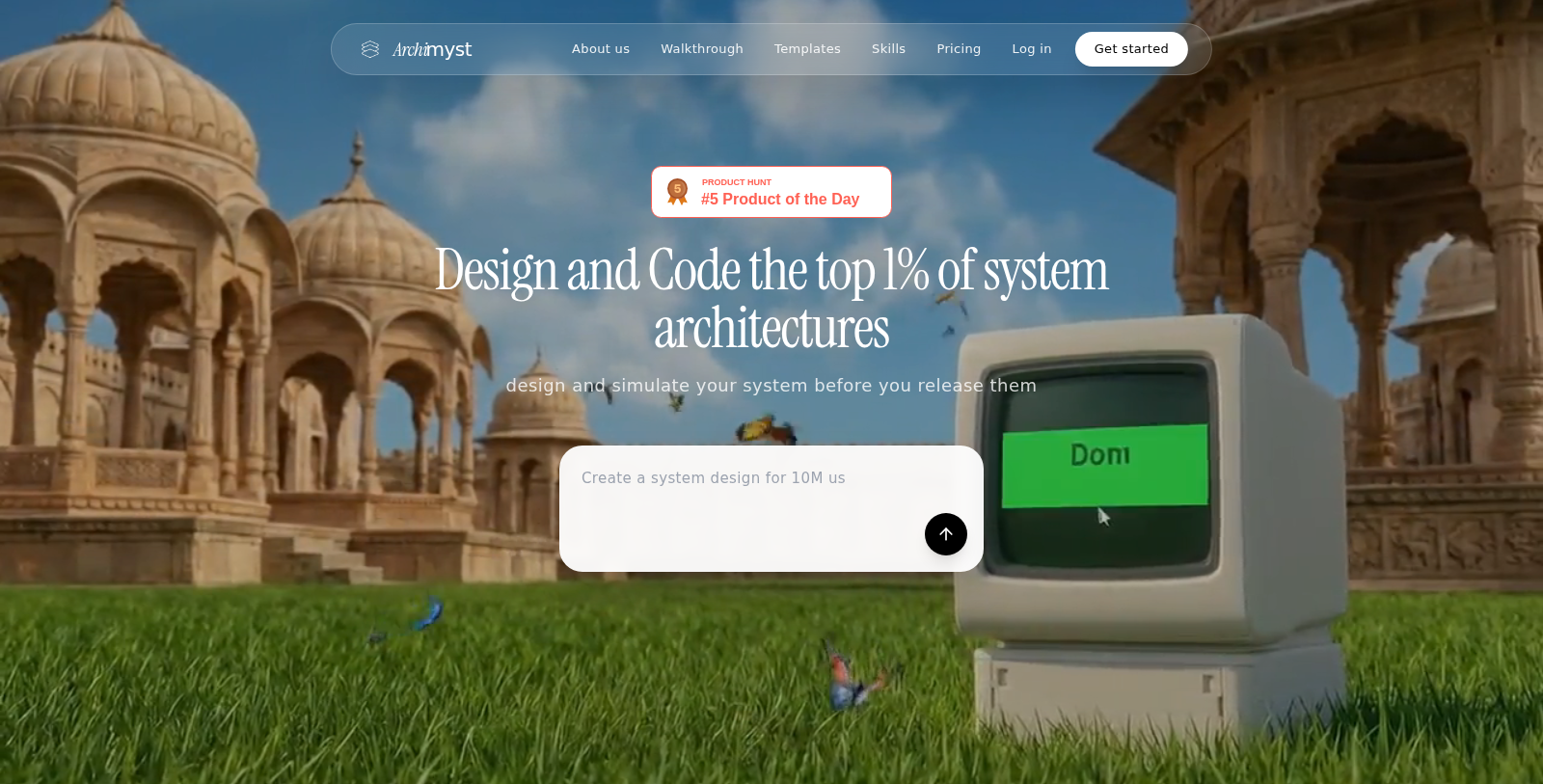
Archimyst is a cutting-edge tool designed to assist engineering teams in creating and managing complex system architectures. With a focus on visual design and chaos engineering simulations, Archimyst enables users to design, test, and refine architectures before production. The tool offers a comprehensive platform that integrates seamlessly with various IDEs, including Cursor and VS Code, enabling a real-time context for engineers as they develop their systems.
One of the key features of Archimyst is its ability to visualize entire system architectures, from backend services to user interfaces. Users can create detailed diagrams that illustrate relationships among components, such as databases, APIs, and microservices. This visualization helps visualize the high-level flows of the architecture and the granular interactions between individual components.
System Design with AI Integration
Archimyst leverages artificial intelligence to enhance the system design process. It allows users to integrate AI agents into their architectures, helping them make decisions on optimal service meshes, database strategies, and other critical infrastructure components. This feature empowers teams to adopt an intelligent approach to system design, catching potential issues and performance bottlenecks early in the process.
Stress Testing and Validation
A standout functionality of Archimyst is its simulation capabilities. Users can conduct precision stress testing to validate their architecture against various real-world scenarios, allowing them to see how their systems will perform under load or when encountering failures. By simulating traffic spikes and introducing latent failures, users can identify potential failure points and make necessary adjustments before deployment.
Flexible Pricing Plans
Archimyst offers various subscription plans to cater to different user needs. The Free plan allows users to manage up to three projects with limited simulation runs. In contrast, the Individual Starter plan includes unlimited projects, advanced chaos engineering features, and automated architecture audits for a monthly fee. For teams, a dedicated plan is available, including shared workspaces and enhanced support. This tiered pricing model ensures that users can select a plan that best fits their requirements.
Collaboration and Workspace Features
Collaboration is made simple with Archimyst, as teams can share workspaces and components, enabling efficient teamwork across projects. The platform's priority support for team members ensures that issues are addressed promptly, fostering a productive environment for system architects and engineers.
Conclusion
Overall, Archimyst positions itself as an essential tool for modern engineering teams looking to streamline their system design and deployment processes. By combining visual design with powerful AI-driven capabilities, Archimyst helps teams validate their systems quickly, allowing for faster iterations and more resilient architectures in an ever-evolving tech landscape.
Pros & Cons
Pros
- Integration with popular IDEs allows real-time context awareness for code generation.
- Supports full-scale system architecture design, enabling visualization of complex stacks.
- Offers stress testing and simulation to identify bottlenecks before production deployment.
Cons
- Some users may find the steep learning curve due to advanced features.
Frequently Asked Questions
Archimyst is free to start, with paid plans from 0 to 100 USD per month.
According to our latest information, this tool does not seem to have a lifetime deal at the moment, unfortunately.
Archimyst can seamlessly integrate with popular IDEs, including Cursor, VS Code, and Claude Code. This integration allows you to maintain a live context of your architecture while coding. Simply connect Archimyst with your preferred IDE to access real-time architectural insights, enabling better, context-aware coding without constantly switching between design and development tools.
Archimyst provides precision stress-testing and simulation capabilities. Users can simulate real-world scenarios by injecting latent failures and generating traffic spikes to observe how their architecture handles extreme conditions. This allows you to identify potential bottlenecks and issues before deployment, ensuring your systems are resilient and can handle high loads.
Yes, Archimyst employs advanced AI agents that analyze your system design for potential bottlenecks and inefficiencies. The platform automatically detects architectural errors and can suggest or apply fixes, such as sharding strategies to optimize performance. This intelligent design feature can save time and improve the overall quality of your architecture.
Archimyst supports a wide range of architectures, including complex microservices systems, databases, and cloud infrastructures across AWS, GCP, and Azure. You can create production-ready designs for various use cases, such as e-commerce platforms, AI applications, and real-time processing systems. The tool provides full-scale architecture support to visualize and optimize your entire stack.
Yes, Archimyst offers collaborative features for teams, including shared workspaces and global component synchronization, as part of the Teams pricing plan. Members can collaborate on architectural designs in real time, enhancing teamwork and ensuring everyone is aligned on the system architecture.
To get the most out of Archimyst, users should have a modern web browser and a willingness to integrate the tool with their favorite IDE. Effective use may also require familiarity with system architecture concepts and cloud services like AWS, GCP, or Azure, depending on the complexity of the systems being designed. The tool is designed to simplify these processes, making it accessible for both new and experienced developers.
Absolutely! Archimyst enables users to visualize and simulate their architectural designs before any code is written. The platform provides an intuitive canvas for representing high-level flows and detailed component interactions. Users can create diagrams and simulate real-world conditions to validate their designs, significantly reducing development time and risk.
While Archimyst is a unique tool that integrates design and simulation, alternatives include Lucidchart, Draw.io, and Microsoft Visio for diagramming, and specialized platforms such as AWS Architecture Diagrams and Google Cloud's architecture design tools. However, Archimyst's combination of real-time simulation and stress testing capabilities makes it distinct in addressing both design and operational concerns.