











Coral

Develop local AI applications using powerful hardware and software tools for efficient on-site processing.
Coral.ai
Is this your tool?
Follow for updates & deals
Get alerts for Coral discounts, feature releases & pricing changes
Similar Tools

Haize Labs
Comprehensive testing solutions to ensure the reliability of AI systems and their safe deployment.

LangChain
A framework for building and deploying applications powered by large language models.

Dualite
Rapidly create and deploy full-stack web and mobile applications with minimal coding and seamless integrations.

Qwen3-Coder
A code model that enhances coding tasks through agentic interactions and extensive context handling.

Continue
Open-source AI code assistant for customizable autocomplete and dynamic coding interactions.

Coral Media Gallery

Coral (review) video
Screenshot of Coral
What is Coral?
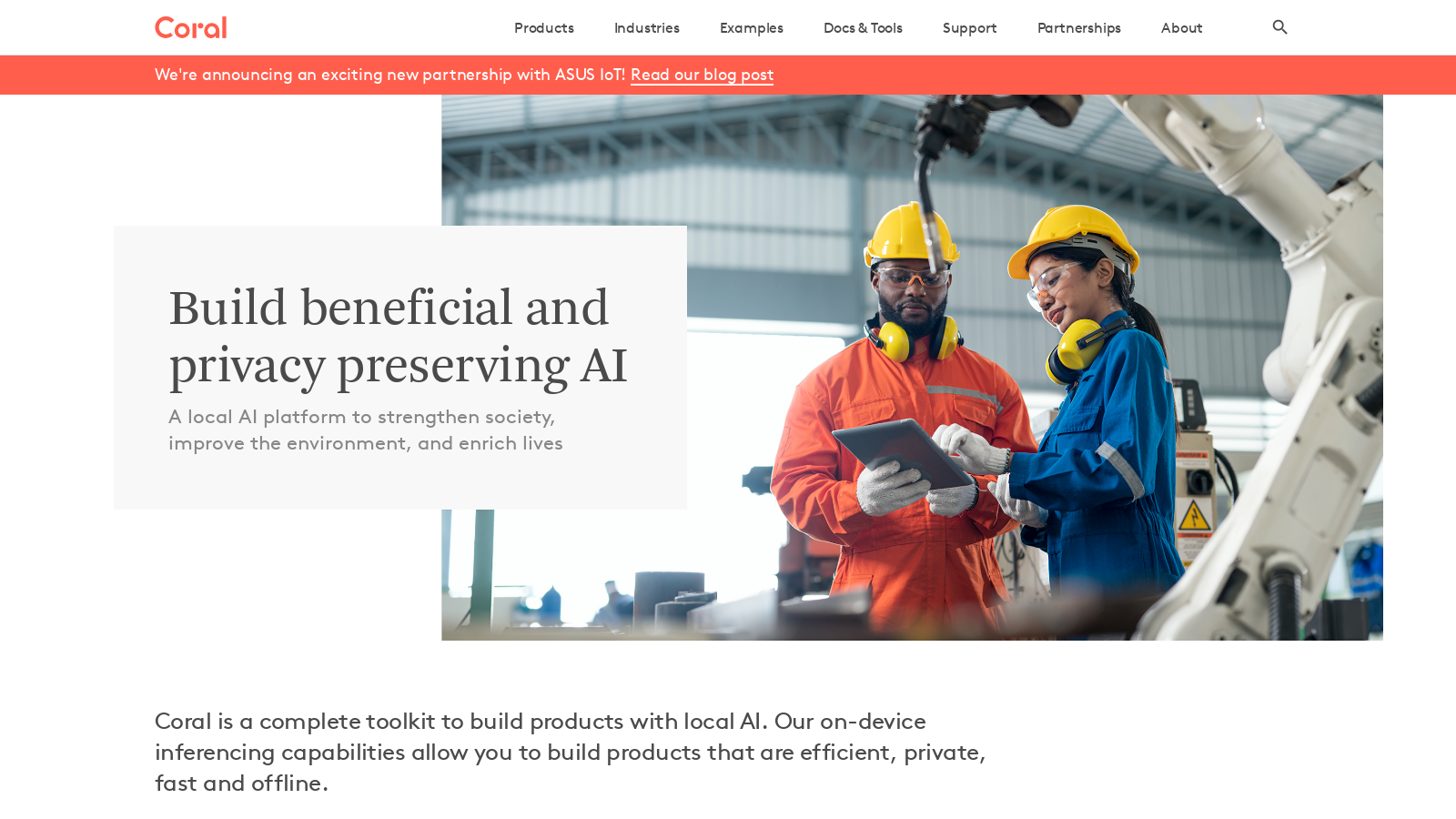
Coral is a powerful platform from Google, crafted specifically for building products that harness local AI capabilities. With a focus on preserving privacy and enhancing efficiency, Coral's technology empowers developers and businesses by providing an extensive toolkit and environment tailored for artificial intelligence applications that require minimal latency and robust performance. The local inferencing features of Coral allow devices to process data directly on-site, thus ensuring rapid responses and superior data security. In an era increasingly defined by artificial intelligence, Coral plays a pivotal role in shaping our technological landscape, driving innovation towards a brighter future.
Innovative Hardware Solutions
The Coral platform boasts an impressive array of hardware offerings, such as the Coral Dev Board, USB Accelerator, and other innovative devices that seamlessly integrate the Edge TPU. This specialized component is critical for enabling powerful on-device machine learning. Each hardware product is meticulously designed to cater to diverse applications, from rapid prototyping for startups to sophisticated production systems for larger enterprises. The modular design facilitates customization, allowing businesses to tailor their setups to the specific needs of their projects.
Recently, Coral has announced an exciting new partnership with ASUS IoT, a collaboration aimed at boosting the manufacturing, distribution, and support of Coral products worldwide. This partnership enhances Coral's capacity to meet the growing demands for intelligent edge computing solutions.
Software and Development Tools
To support its robust hardware ecosystem, Coral offers a comprehensive suite of software tools that simplify the creation and deployment of AI applications. Developers gain access to a collection of libraries—including TensorFlow Lite—along with pre-trained models that can expedite project initiation. This rich development environment caters not only to seasoned programmers but also to novices, thereby promoting broader participation in the advancement of local AI.
Applications Across Diverse Industries
Coral's technology finds extensive applications across various sectors, including healthcare, automotive, agriculture, and the development of smart cities. In healthcare, local AI enhances patient monitoring and diagnostics, while in agriculture, it optimizes crop management and soil assessment, leading to increased productivity and sustainability. The automotive industry leverages Coral's capabilities to improve vehicle safety and efficiency. As the demand for smart, connected devices continues to rise, Coral stands ready to support and elevate these transformative applications.
Healthcare Innovations
In the healthcare realm, AI is making profound contributions by reducing costs and improving patient outcomes. With the capability to analyze patient data on-site, Coral's devices ensure privacy while enabling precise monitoring and timely intervention in clinical settings. For instance, solutions employing Coral can serve as effective tools for patient monitoring, alerting staff without compromising sensitive information. In creations like Virgo’s endoscopic video system, Coral significantly aids in the fight against deadly diseases such as colon cancer.
Smart Cities Development
Coral's impact extends to the development of smart cities, where AI integration facilitates improved urban living conditions. By processing data locally, Coral aids in understanding population patterns, optimizing traffic flow, and enhancing public safety measures. Applications include real-time monitoring of public spaces, which not only preserves privacy but also ensures efficient city management.
Agricultural Advancements
Agriculture is another field benefiting from Coral’s local AI capabilities. Farmers can utilize Coral devices for soil analysis and crop monitoring, leading to better yield predictions and disease management. The ability to run real-time diagnostics allows for quicker responses to agricultural challenges, thereby safeguarding food resources and promoting sustainable farming practices.
Automotive Enhancements
Coral’s technology plays a crucial role in enhancing automotive safety features, including driver attentiveness detection and predictive maintenance systems. Vehicles equipped with Coral solutions can analyze sensor data to predict mechanical failures, optimize performance, and ensure passengers' safety.
Conclusion
As we delve further into an age characterized by remarkable advancements in artificial intelligence, platforms like Coral that prioritize efficiency, privacy, and user accessibility will undeniably shape the future landscape of technology. With its combination of state-of-the-art hardware, user-friendly software, and versatile application potential, Coral is well-positioned to catalyze innovation, enabling the creation of next-generation intelligent devices that redefine our interaction with the world.
Continuous Innovation
Coral's ongoing evolution reflects a commitment to driving forward the capabilities of local AI. By integrating contemporary technologies and fostering partnerships, such as the one with ASUS IoT, Coral is not just keeping pace with the rapid advancement of AI applications; it is leading the charge, empowering developers and enterprises worldwide to harness the full potential of edge AI for a better tomorrow.
Pros & Cons
Pros
- Offers on-device AI processing, ensuring fast, efficient, and privacy-preserving applications.
- Supports a wide range of AI models and applications across various industries like healthcare and agriculture.
- Provides flexible hardware options for both prototyping and production to accommodate different user needs.
Frequently Asked Questions
Coral is free to start, with paid plans from 0 to 0 USD per Translation not found for 'time_period_unknown'.
According to our latest information, this tool does not seem to have a lifetime deal at the moment, unfortunately.
Coral supports a variety of use cases across multiple industries, including healthcare, automotive, smart cities, agriculture, and manufacturing. For instance, in healthcare, Coral enables accurate diagnostic tools, patient monitoring, and medication compliance tracking. In the automotive industry, it aids in ensuring driver attentiveness and predictive vehicle maintenance. Additionally, Coral is utilized in smart cities for optimizing traffic flow and enhancing pedestrian safety, as well as in agriculture for improving crop yield and soil analysis.
To get started with Coral, you can begin by selecting one of their prototyping products, like the Coral Dev Board or USB Accelerator. Visit the official Coral documentation for setup guides specific to your device. The documentation provides detailed instructions on connecting cameras, using I/O pins, and flashing your board with Mendel Linux, as well as examples of running pre-trained models in Python or C++. Additionally, you can explore tutorials available on their examples page to understand various use cases.
Coral's Edge TPU supports TensorFlow models, specifically those converted into the TensorFlow Lite format. This includes a range of models for image classification, object detection, semantic segmentation, pose estimation, and audio classification. Users can either download pre-compiled models available on the Coral website or create their own models using TensorFlow and then optimize them for Edge TPU using the Edge TPU Compiler.
Coral requires specific software libraries to be installed, depending on the device you are using. For example, the Coral Dev Board runs on Mendel Linux, which is an optimized Debian derivative. When using Coral accelerators like the USB or PCIe modules, a compatible Debian-based host operating system (Debian 6.0 or higher) is needed. The software for Coral includes the Edge TPU runtime, PyCoral API, and various pre-compiled models. Ensure that your hardware meets the requirements detailed in the Coral documentation for your chosen device.
Yes, one of the key features of Coral's platform is its ability to perform AI inferencing locally, which means that many applications can run offline without needing internet connectivity. This is particularly advantageous for deployment in remote areas or in applications where data privacy is critical, since no sensitive information is sent to the cloud. Users can develop and deploy various models that work entirely off the device.
Coral enhances data privacy by performing all AI inference locally on the device rather than streaming data to the cloud. This means that user data remains on the device, allowing developers to control when and if data is stored or transferred. This approach minimizes the risk of data breaches and complies with privacy regulations by ensuring that sensitive information is not sent outside of the local environment.
To optimize performance using Coral, ensure your models are quantized appropriately for the Edge TPU, as this can significantly enhance inferencing speed. Utilize model pipelining to run multiple models on different Edge TPUs concurrently, which increases overall throughput. Regularly update to the latest version of the Edge TPU runtime and use the PyCoral libraries to streamline model deployment. Additionally, test and profile your application under real-world conditions to identify and address performance bottlenecks.
Coral offers multiple support channels for users, including an extensive documentation section covering hardware setup and software development. If you encounter issues, you can ask questions on Stack Overflow, where the Coral community engages, or report bugs through their GitHub repository. For direct technical inquiries, Coral has a support team that promises to respond within one business day. Users can also sign up for newsletters to stay updated on the latest Coral news and features.