











GPT Researcher

Generates comprehensive research reports by autonomously sourcing data from web and local documents.
Github.com
Is this your tool?
Follow for updates & deals
Get alerts for GPT Researcher discounts, feature releases & pricing changes
Similar Tools

ChatPDF
Interactively query PDF documents to extract information and insights using AI.

01.AI
AI platform enabling enterprises to deploy customized solutions and integrate deep learning into existing workflows.

Craft
Create, organize, and share documents with a flexible block-based system across all devices.

Humata
Transform your documents into an interactive knowledge base for quick insights and answers.

FAQ Ally
Transform documents into AI-driven knowledge bases for small businesses to enhance customer interaction.

GPT Researcher Media Gallery

GPT Researcher (review) video
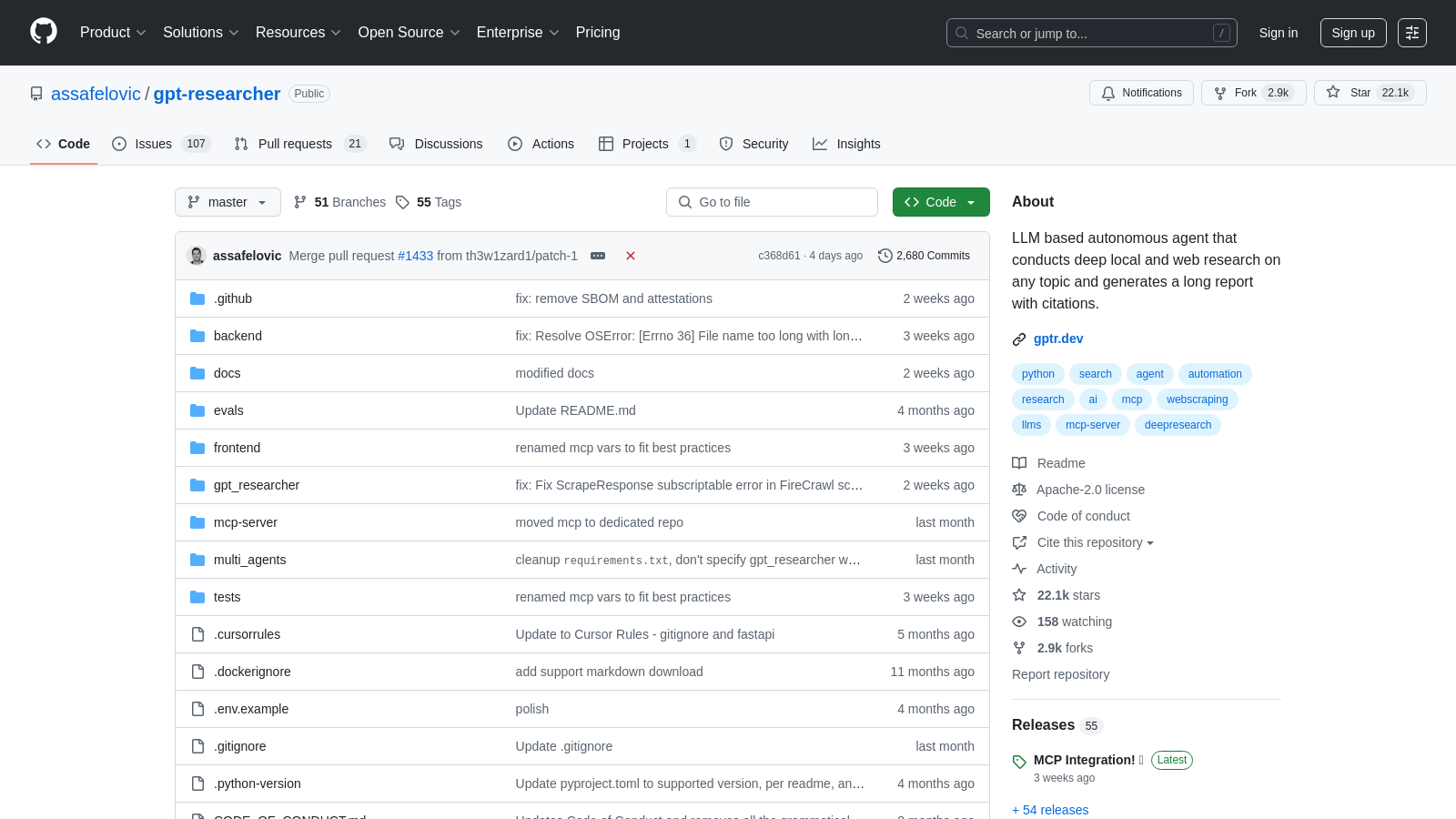
Screenshot of GPT Researcher
What is GPT Researcher?
GPT Researcher is an open deep research agent designed for conducting comprehensive web and local research on any topic. This innovative tool produces detailed, factual, and unbiased research reports complete with citations from credible sources. Offering a fully customizable framework, GPT Researcher allows users to create task-specific and domain-tailored research agents. With inspiration drawn from recent Plan-and-Solve and Retrieval-Augmented Generation (RAG) methodologies, GPT Researcher effectively addresses issues of misinformation, and enhances both speed and reliability by executing tasks in parallel.
Why Use GPT Researcher?
Manual research can be a time-consuming process, often taking weeks and requiring significant resources. Traditional large language models (LLMs) trained on outdated data are prone to hallucination, making them ineffective for current research tasks. Moreover, many LLMs face token limitations, making them insufficient for generating lengthy research reports. Consequently, existing services often yield shallow results due to limited web sources, which can introduce bias into research conclusions. With GPT Researcher, users can leverage a robust solution that aims at delivering objective findings quickly and efficiently.
Architecture
At the core of GPT Researcher's functionality lie two crucial components: the planner and the execution agents. The planner is responsible for generating pertinent research questions, which are subsequently addressed by execution agents that gather information. Finally, the publisher aggregates the resulting insights into a coherent research report. This multi-agent architecture empowers GPT Researcher to execute elaborate and thorough research tasks.
Key Features:
- Generates detailed research reports using both web and local documents.
- Smart image scraping and filtering to enhance report visuals.
- Reports can exceed 2,000 words, providing comprehensive insights.
- Aggregates information from over 20 sources for well-rounded conclusions.
- Includes a lightweight frontend based on HTML/CSS/JS and a more complex, production-ready Next.js application.
- Facilitates JavaScript-enabled web scraping for enhanced data collection.
- Maintains memory and context throughout the research process, allowing for better adherence to research scope.
- Supports exports to various formats, including PDF, Word, and Markdown, making it easy to share findings.
Advanced Functionalities:
The introduction of the Deep Research feature allows users to engage in recursive, in-depth exploration of topics. This feature utilizes a tree-like research model that facilitates detailed analysis of subtopics while maintaining an overall thematic direction. The system not only accelerates research processing but also enhances clarity across complex subjects.
The latest iteration of GPT Researcher integrates AI-generated inline images, enriching the visual aspects of reports by using Google's Gemini AI models (Nano Banana) to provide illustrations relevant to the research context.
Tutorials and Documentation
Comprehensive tutorials and API references are readily available to assist users with installation, configuration, and optimization of their research agents. Through these resources, users can learn to tailor their research processes to specific needs, customize settings, and tap into the full potential of the application.
Community and Contributions
As a project that fosters community involvement, GPT Researcher is open-source and encourages contributions from developers and researchers alike. This collaborative aspect allows for continuous improvements and enhancements to the tool, directly benefiting the broader research community.
In conclusion, GPT Researcher is an indispensable asset for anyone seeking to elevate their research capabilities. By integrating state-of-the-art AI technologies with reliable research methodologies, it not only transforms traditional paradigms but also empowers individuals and organizations to obtain accurate, relevant, and comprehensive research outcomes.
Pros & Cons
Pros
- Conducts deep research leveraging web and local document sources for comprehensive reports.
- Generates objective and factual research reports with citations, reducing biases in findings.
- Offers extensive customization options for creating domain-specific research agents.
Frequently Asked Questions
GPT Researcher is open source and free to use.
According to our latest information, this tool does not seem to have a lifetime deal at the moment, unfortunately.
GPT Researcher offers advanced capabilities for conducting in-depth research on the deep web and local sources across various topics. It generates detailed, factual, and unbiased research reports that can exceed 2,000 words and cite over 20 sources. The tool is designed to explore subtopics thoroughly and offers bright image scraping for report inclusion, ensuring the generation of rich content.
GPT Researcher supports MCP (Multi-Channel Processing) integration, enabling users to connect specialized data sources, including GitHub repositories and APIs. By configuring the environment variable 'RETRIEVER', users can enable hybrid research that combines web scraping with specific data retrieval, enhancing the scope and reliability of the study conducted.
GPT Researcher can analyze various local document formats, including PDFs, plain text, CSVs, Excel spreadsheets, Markdown files, PowerPoint presentations, and Word documents. You need to set the 'DOC_PATH' environment variable to point to the folder containing these documents, enabling the tool to include them in research tasks.
To get started with GPT Researcher, you need to install Python version 3.11 or later. After cloning the repository, set up API keys for external integrations (such as OpenAI and Tavily) by either exporting them in the terminal or creating a .env file. Finally, install the necessary dependencies using 'pip install -r requirements.txt' and start the application using 'python -m uvicorn main: app-- -reload'.
The Deep Research feature utilizes a recursive workflow that delves deeply into topics, systematically exploring related subtopics. Users can configure the depth and breadth of exploration, and the process includes concurrent processing for faster results. Typically, a deep research instance takes around 5 minutes and costs approximately ?.4, depending on the reasoning effort selected.
Absolutely! GPT Researcher allows users to create task-specific agents tailored to particular research queries. This customization helps generate targeted questions and optimize the information gathered, ensuring the research is relevant and meets specific domain requirements.
Reports generated by GPT Researcher can be exported in multiple formats, including PDF, Word, and Markdown. This flexibility allows users to easily share or publish their research findings in a preferred format.
Yes, GPT Researcher has a dedicated community on Discord and provides a range of documentation and tutorials on its GitHub repository. Users can also submit issues on GitHub for troubleshooting or feature requests, ensuring they have access to the resources needed to utilize the tool effectively.