







Open Interpreter

AI-powered
Open-source coding agent for the terminal, built to get strong results from low-cost and open-weight models.
Openinterpreter.comOpens in new tabIs this your tool? Claim this page
Claim Your Tool Page
Free to claim • Premium features available
- Verified Badge – Show users your tool is legitimate with a verified checkmark that builds instant credibility.
- Edit Your Profile – Update descriptions, screenshots, pricing, and keep your listing accurate and up-to-date.
- Boost Visibility – Get featured placements, priority listing in categories, and promotional badges to stand out.
- Respond to Reviews – Engage with your users by responding to feedback and building trust with potential customers.
Follow for updates & deals
Get alerts for Open Interpreter discounts, feature releases & pricing changes
Similar Tools

AI2SQL
Generate SQL queries from natural language input without prior programming knowledge.

ClickUp
An all-in-one platform for task management, collaboration, and workflow automation.

Taskade
Create dynamic applications and automations using AI without coding.

Tavus
AI companions that adapt to user preferences for natural and intuitive conversations.

Sana
Create AI agents that automate tasks and integrate with your company’s knowledge base.

Context Link
Share personal links with AI for contextual understanding of your existing content

Craft
Create, organize, and share documents with a flexible block-based system across all devices.

Sheet0
Manage data efficiently using a chat-like interface for scraping, summarization, and analysis.
New Tools

Text Generator
OpenAI-compatible API giving access to many AI text, vision and speech models through one endpoint

RambleFix
Turns spoken voice notes into polished emails, notes and summaries on web, iPhone and Mac

QuickCreator
AI content team of agents that researches, writes and optimizes SEO articles in your brand voice

Linfo.ai
Summarizes articles, YouTube videos and documents into takeaways, outlines and mind maps

Brain Pod AI
AI platform for writing, images and chat, now evolving into Charigent with AI characters and workflows

AutoBlogging.Pro
Generates SEO-optimized blog articles with GPT models and publishes them to WordPress automatically

Vsub
Turns a script or voiceover into narrated, illustrated faceless videos using your own style template

VideoToPage
Turns YouTube videos, uploads and recordings into blog posts, articles and social posts

Open Interpreter Media Gallery
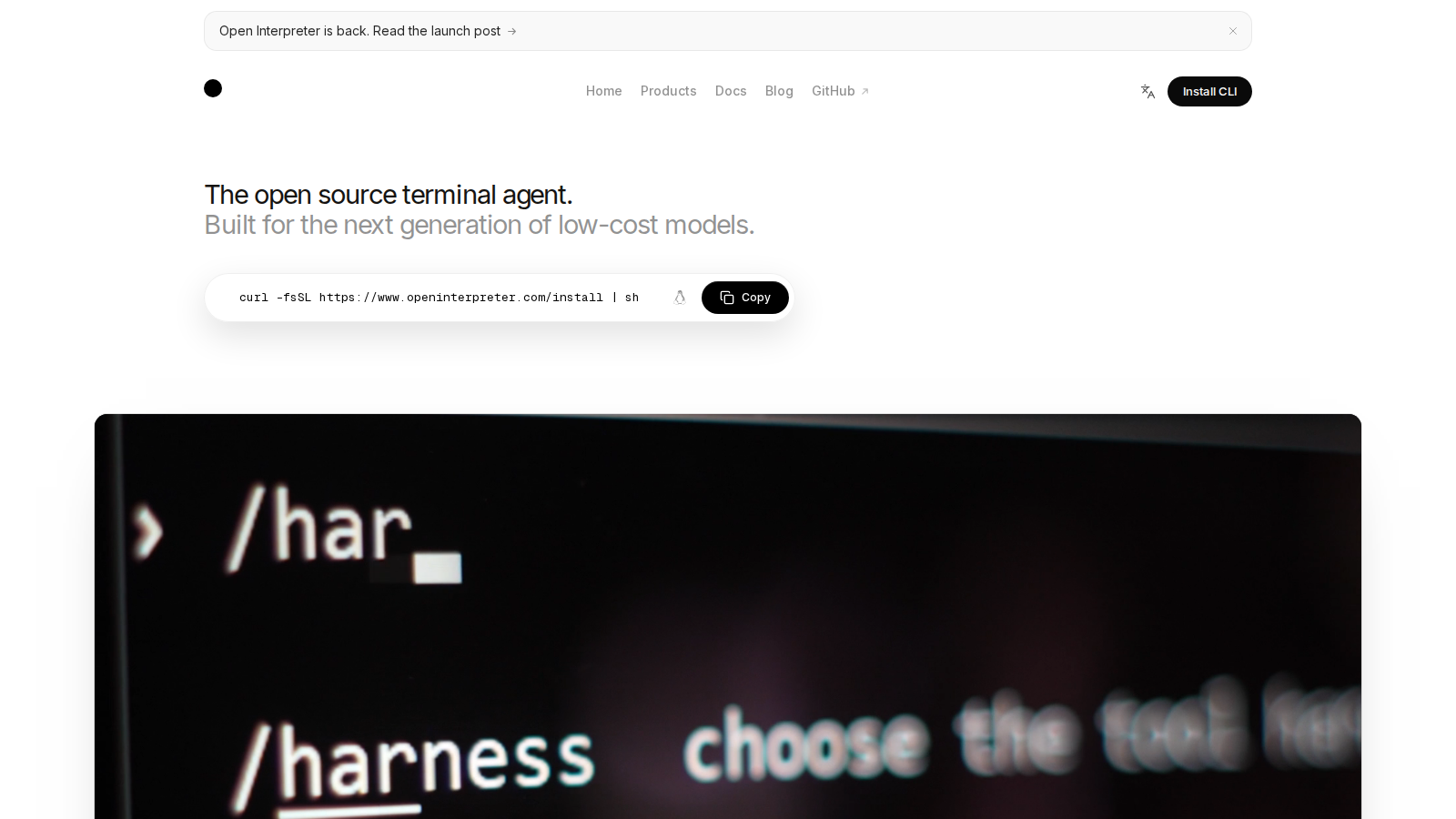
Screenshot of Open Interpreter
What is Open Interpreter?
Open Interpreter is an open-source coding agent for the terminal. The project describes itself as a coding agent built for low-cost and open-weight models. It is released under the Apache-2.0 license, and the current version is a Rust rewrite based on a fork of OpenAI's Codex.
The agent emulates agent harnesses that get strong performance from low-cost models. You can switch providers and models with the /model command and switch harnesses with /harness. It works with OpenAI-compatible providers through the Chat Completions API, and the project offers provider guides for models such as Kimi K3, DeepSeek and Z.AI GLM.
Commands run inside native sandboxing on macOS, Linux and Windows. The agent supports exec, MCP, skills, hooks and permissions, reuses shared AGENTS.md files and .agents/skills folders, and includes a built-in QA skill for testing web and native apps. It can also run as an Agent Client Protocol agent for editors with the acp command.
Installation is a one-line script from the official site, using curl on macOS and Linux or PowerShell on Windows. After that you start it by typing i in the terminal. The earlier Python version of Open Interpreter continues as a community fork. Model costs depend on the provider you choose, so see the official site and GitHub repository for current details.
Pros & Cons
Pros
- Open source under the Apache-2.0 license
- Built for low-cost and open-weight models
- Native sandboxing on macOS, Linux and Windows
Cons
- Command-line tool, less suited to non-developers
- Model usage is billed by the provider you choose
Frequently Asked Questions
How much does Open Interpreter cost?
Open Interpreter is free to start, with paid plans from 0 to 20 USD per month.
Does Open Interpreter have a lifetime deal?
According to our latest information, this tool does not seem to have a lifetime deal at the moment, unfortunately.
What is Open Interpreter?
Open Interpreter is an open-source coding agent for the terminal. It is built to get strong results from low-cost and open-weight models, and the current version is a Rust rewrite based on a fork of Codex.
Which models does Open Interpreter work with?
It works with OpenAI-compatible providers through the Chat Completions API. The project has provider guides for Kimi K3, DeepSeek and Z.AI GLM, and you switch models with the /model command.
Is Open Interpreter open source?
Yes. The project is published on GitHub under the Apache-2.0 license, so you can read, use and modify the code under the terms of that license.
How do I install Open Interpreter?
Run the install script from the official site: a curl command on macOS and Linux, or a PowerShell command on Windows. Then start the agent by typing i in your terminal.
Is this the same as the older Python Open Interpreter?
No. The current project is a Rust rewrite based on a fork of Codex. The original Python project continues as a community fork maintained separately.
Does Open Interpreter run commands in a sandbox?
Yes. It runs commands inside native sandboxing on macOS, Linux and Windows, and it supports permissions and hooks to control what the agent may do.
Open Interpreter Comparisons

Notice: This website uses affiliate links to earn commissions from sales. Please read their ToS when signing up somewhere.