







OpenAssistantGPT
AI-powered
No-code platform for building RAG chatbots and AI agents trained on your website and files
Openassistantgpt.ioOpens in new tabIs this your tool? Claim this page
Claim Your Tool Page
Free to claim • Premium features available
- Verified Badge – Show users your tool is legitimate with a verified checkmark that builds instant credibility.
- Edit Your Profile – Update descriptions, screenshots, pricing, and keep your listing accurate and up-to-date.
- Boost Visibility – Get featured placements, priority listing in categories, and promotional badges to stand out.
- Respond to Reviews – Engage with your users by responding to feedback and building trust with potential customers.
Follow for updates & deals
Get alerts for OpenAssistantGPT discounts, feature releases & pricing changes
Similar Tools

CustomGPT.ai
No-code platform for building AI agents and chatbots from your own business content

EmbedAI
No-code builder for custom ChatGPT chatbots trained on your own files, websites and videos
WizyChat
Custom GPT chatbots trained on your website and files, built with a drag-and-drop visual builder
Toki
AI executive assistant that handles emails, scheduling, bookings and important matters for you

Pally
AI personal assistant you text, handling email, calendar, reminders, research and errands

Omnifact
GDPR-compliant enterprise AI platform with a privacy filter, hosted in Germany or on-premises

Moveo.AI
AI agents for customer service, collections and payments across chat and messaging channels

Mendable
Platform to train an AI chat assistant on your docs and data and embed it for customer support
New Tools

Text Generator
OpenAI-compatible API giving access to many AI text, vision and speech models through one endpoint
RambleFix
Turns spoken voice notes into polished emails, notes and summaries on web, iPhone and Mac

QuickCreator
AI content team of agents that researches, writes and optimizes SEO articles in your brand voice

Linfo.ai
Summarizes articles, YouTube videos and documents into takeaways, outlines and mind maps

Brain Pod AI
AI platform for writing, images and chat, now evolving into Charigent with AI characters and workflows

AutoBlogging.Pro
Generates SEO-optimized blog articles with GPT models and publishes them to WordPress automatically

Vsub
Turns a script or voiceover into narrated, illustrated faceless videos using your own style template
VideoToPage
Turns YouTube videos, uploads and recordings into blog posts, articles and social posts

OpenAssistantGPT Media Gallery
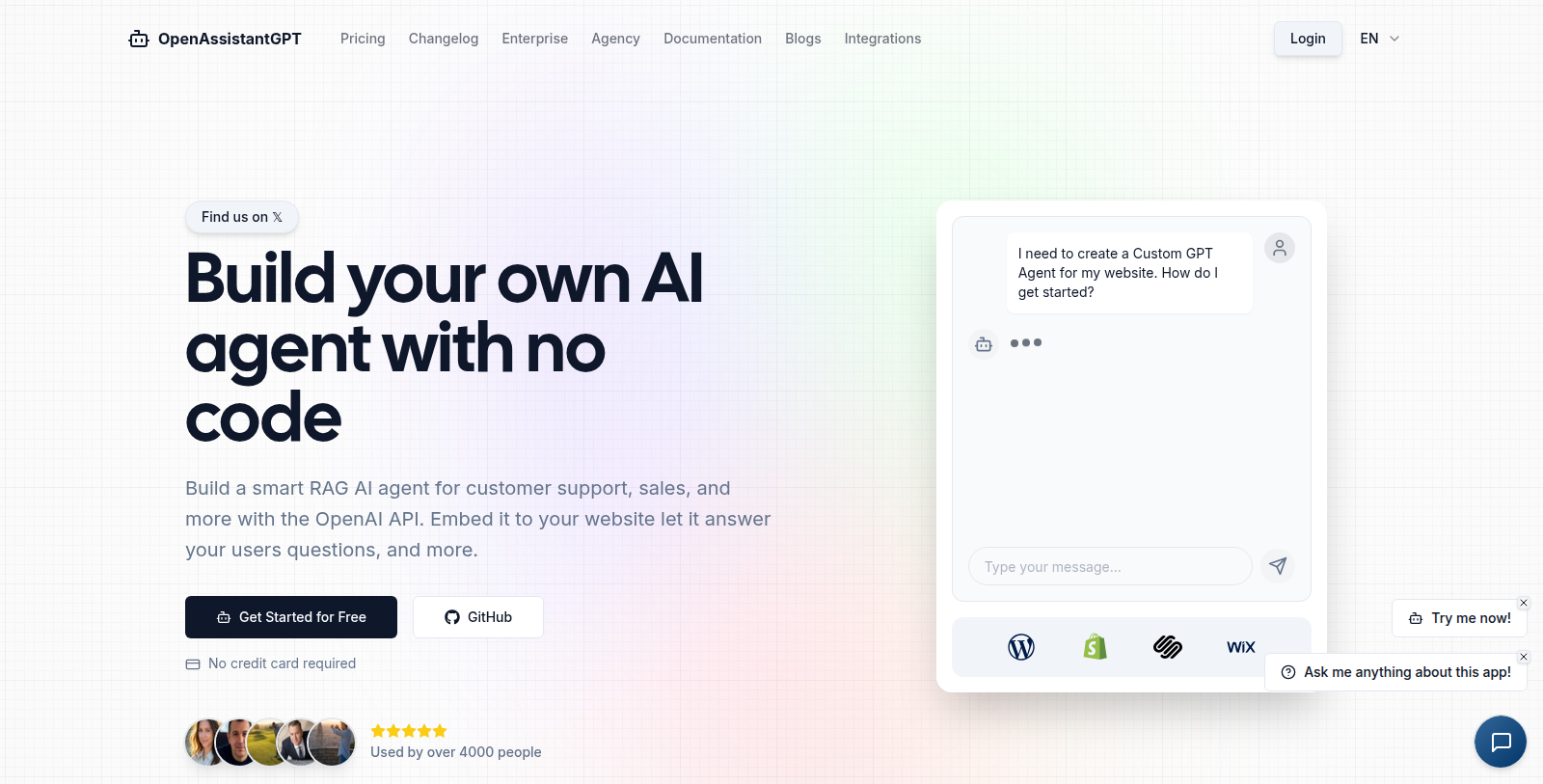
Screenshot of OpenAssistantGPT
What is OpenAssistantGPT?
OpenAssistantGPT is a no-code platform for building chatbots and AI agents for customer support, sales and similar uses. It is powered by the OpenAI API and lets you pick models such as GPT-4o.
You give it a website URL to crawl or upload files such as CSV, XML or images, and the chatbot answers questions from that content. The bot can be embedded in your website. Further features listed on the site include lead collection through user inquiries, AI agent actions that query API endpoints, web search, and SAML/SSO authentication for private chatbots.
The project is open source, with its code on GitHub. A free plan with one chatbot is available, and paid plans add more chatbots, customization and custom domains. An enterprise plan is offered on request.
Pros & Cons
Pros
- Trains chatbots on a crawled website or uploaded CSV, XML and image files.
- The project is open source, with its code published on GitHub.
Cons
- The platform depends on the OpenAI API and its available models.
Frequently Asked Questions
How much does OpenAssistantGPT cost?
OpenAssistantGPT is available at no cost.
Does OpenAssistantGPT have a lifetime deal?
According to our latest information, this tool does not seem to have a lifetime deal at the moment, unfortunately.
How does OpenAssistantGPT learn from my content?
You give it a website URL to crawl, or upload files such as CSV, XML or images. The chatbot then answers visitor questions using that material. Once it is set up, the bot can be embedded in your website, so visitors can ask questions without leaving the page.
Can the chatbot do more than answer questions?
The site lists AI agent actions that query API endpoints, along with web search. Lead collection through user inquiries is also available, so the bot can capture details from interested visitors. The exact setup depends on how each agent is configured, so review the documentation first.
Is the OpenAssistantGPT code available to inspect?
The project is open source, and its code is published on GitHub. That lets technical teams review how the platform works before adopting it. Plan details and feature tiers are listed on the official website, where you can compare the options that fit your use case.
How can I keep private chatbots restricted?
The site lists SAML and SSO authentication for private chatbots, which lets you control who can use them. The platform is powered by the OpenAI API, and you can choose models such as GPT-4o. Confirm authentication details on the website before rolling a private bot out to your staff.
Notice: This website uses affiliate links to earn commissions from sales. Please read their ToS when signing up somewhere.