







SQLAI.ai

AI-powered
AI SQL generator that writes, optimizes, validates and explains queries from plain language
Sqlai.aiOpens in new tabIs this your tool? Claim this page
Claim Your Tool Page
Free to claim • Premium features available
- Verified Badge – Show users your tool is legitimate with a verified checkmark that builds instant credibility.
- Edit Your Profile – Update descriptions, screenshots, pricing, and keep your listing accurate and up-to-date.
- Boost Visibility – Get featured placements, priority listing in categories, and promotional badges to stand out.
- Respond to Reviews – Engage with your users by responding to feedback and building trust with potential customers.
Follow for updates & deals
Get alerts for SQLAI.ai discounts, feature releases & pricing changes
Similar Tools

Text Generator
OpenAI-compatible API giving access to many AI text, vision and speech models through one endpoint

Runware
One API for image, video, audio, language and 3D AI models, plus serverless and reserved GPUs

Respan
Open-source AI gateway with built-in observability, prompt management and evaluations
Luxand.cloud
Cloud face recognition API for detecting, matching and searching faces in web and mobile apps

Promptmetheus
Prompt engineering IDE for composing, testing and optimizing prompts across 150+ LLMs
Novita AI
AI cloud offering model APIs, agent sandboxes and GPU instances for developers

Cekura
Automated testing and monitoring platform for voice and chat AI agents

Pig
API and chat interface for launching and automating Windows apps with computer-use AI
New Tools

RambleFix
Turns spoken voice notes into polished emails, notes and summaries on web, iPhone and Mac

QuickCreator
AI content team of agents that researches, writes and optimizes SEO articles in your brand voice

Linfo.ai
Summarizes articles, YouTube videos and documents into takeaways, outlines and mind maps

Brain Pod AI
AI platform for writing, images and chat, now evolving into Charigent with AI characters and workflows

AutoBlogging.Pro
Generates SEO-optimized blog articles with GPT models and publishes them to WordPress automatically

Vsub
Turns a script or voiceover into narrated, illustrated faceless videos using your own style template

VideoToPage
Turns YouTube videos, uploads and recordings into blog posts, articles and social posts

SQLAI.ai Media Gallery
Screenshot of SQLAI.ai
What is SQLAI.ai?
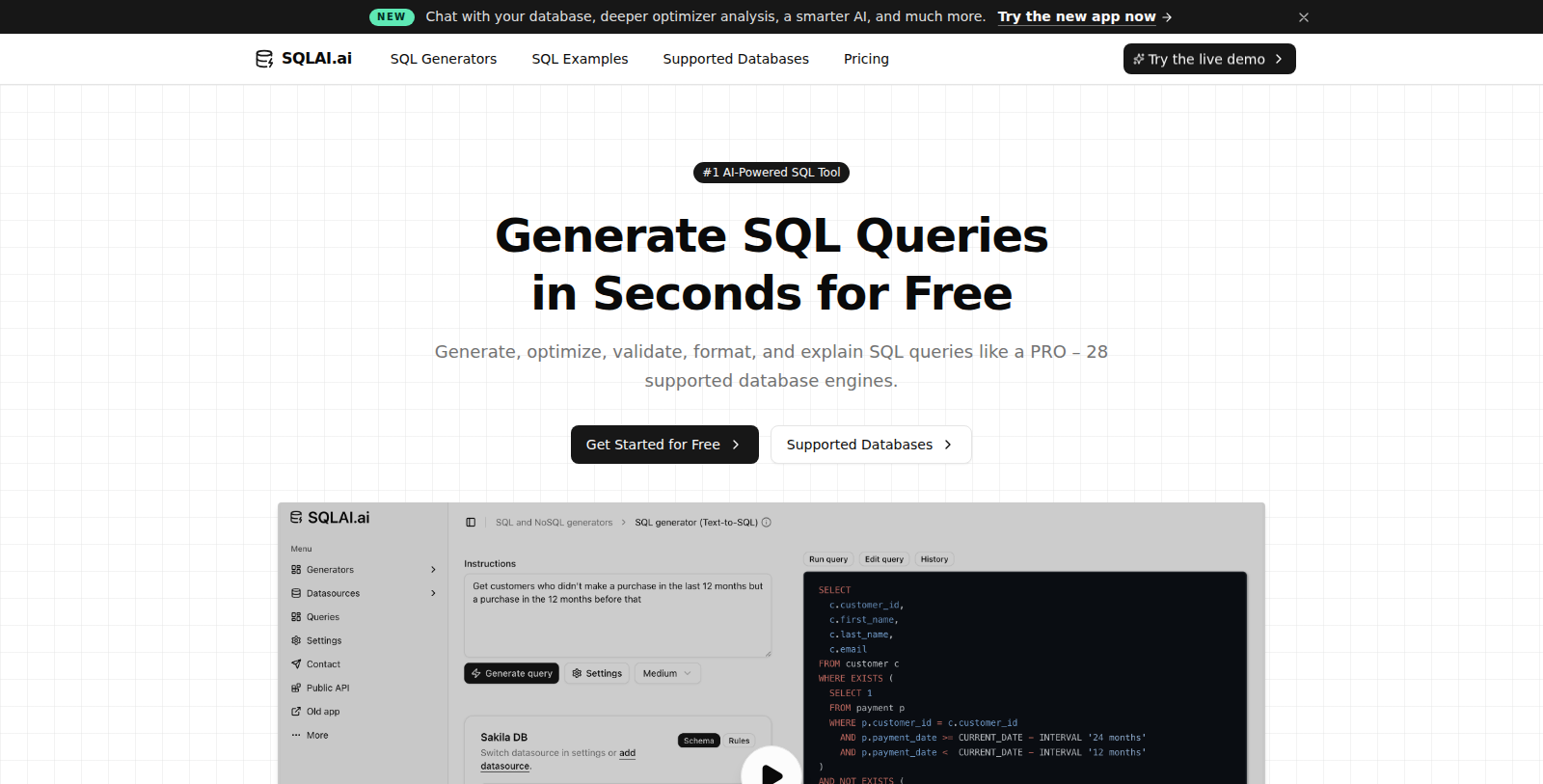
SQLAI.ai is a web-based tool that converts plain-language requirements into SQL and NoSQL queries. Besides the text-to-SQL generator, it offers an optimizer for slow queries, a validator that points out syntax errors and suggests fixes, an explainer that breaks a query down step by step, and a formatter.
Users can import a database schema or connect a database so the AI has schema-aware context when generating queries, and can run natural-language queries against connected databases. The service lists support for dozens of database engines, from Postgres to Snowflake, and offers public API access.
It is aimed at developers, analysts and data teams who write SQL regularly. Paid plans start with a 7-day trial and are limited by monthly query counts; team members and databases are unlimited.
Pros & Cons
Pros
- Converts plain-language requirements into SQL and NoSQL queries across many engines.
- Optimizer, validator and explainer work on existing queries, not only newly generated ones.
Cons
- Paid plans are limited by a monthly query count.
Frequently Asked Questions
How much does SQLAI.ai cost?
SQLAI.ai is a paid service. Check their website for pricing.
Does SQLAI.ai have a lifetime deal?
According to our latest information, this tool does not seem to have a lifetime deal at the moment, unfortunately.
Can it turn plain English into SQL for my database?
Yes, the tool converts plain-language requirements into SQL and NoSQL queries. You can import a database schema or connect a database so generated queries reflect your actual tables. It can also run natural-language queries against a connected database. Schema context gives the generator the table names and structure it needs.
What can I do with a query I already wrote?
Existing queries can go through an optimizer for slow queries, a validator that points out syntax errors and suggests fixes, and an explainer that breaks a query down step by step. A formatter is included as well. These tools are useful when you inherit SQL written by someone else.
Which database engines are supported?
The service lists support for dozens of database engines, ranging from Postgres to Snowflake. Public API access is also offered for developers who want to build queries into their own systems. The current engine list should be confirmed on the vendor site.
Who will get the most out of this tool?
It is aimed at developers, analysts and data teams who write SQL on a regular basis. Schema-aware context helps when a query spans several related tables. Teams that handle many databases will appreciate the connection options. Anyone who writes queries by hand daily can use it to draft faster and then check the results.
Are there usage limits I should know about?
Paid plans are limited by monthly query counts, so heavy users should keep an eye on their usage. Team members and databases are not capped on those paid plans. Exact allowances for each tier are best checked directly on the official pricing page.
Notice: This website uses affiliate links to earn commissions from sales. Please read their ToS when signing up somewhere.